
A school or university campus is one of the most heavily scheduled environments there is, and one of the least measured. The timetable says a lecture theatre is booked from nine, a library is open until midnight, a science block is in use all afternoon. What the timetable never tells the estates team is whether anyone actually showed up. A booked room sits empty when a lecturer moves online. A study space the timetable ignores is rammed at exam time. A building scheduled to close at six still has students in it at eight because that is where the good desks are.
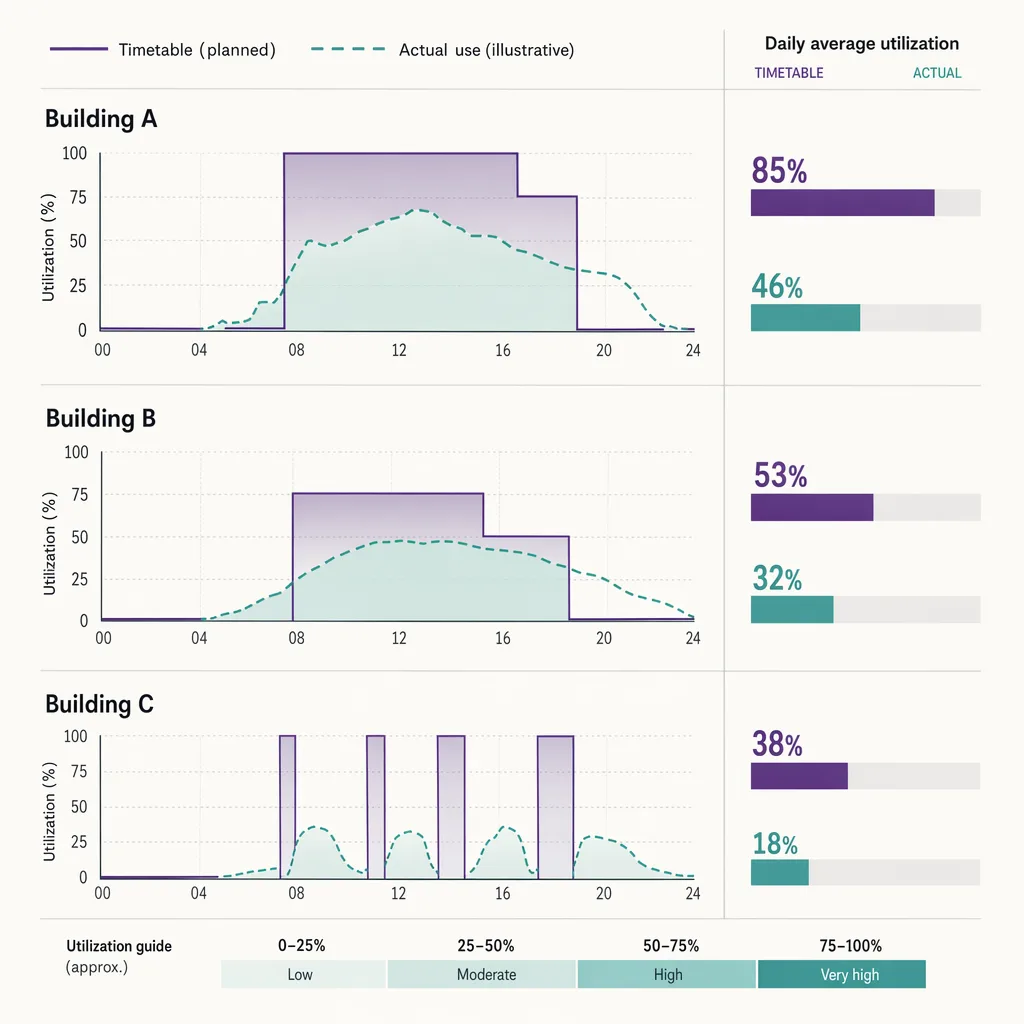
That gap between the planned use and the real use costs money and frustrates planning. Cleaners service rooms nobody entered. Heating runs in half-empty buildings. A capital case for a new study block competes with existing space that turns out to be underused, or fully used at hours the timetable never captured. Foot-traffic counting closes the gap by measuring the building as it is actually used, by hour, without identifying a single pupil or student. This guide covers what that data shows and how a campus puts it to work.
Why measure foot traffic across a campus?
A school or university campus runs dozens of buildings whose real use is invisible to the timetable. Foot-traffic counting shows which libraries, labs, and study spaces are actually busy by hour, which entrances carry the load between lessons, and which rooms are booked but empty. That informs cleaning rounds, opening hours, energy use, and the case for new or repurposed space. Counting at doors, camera-free and without identifying any pupil, keeps the data well inside what a school can responsibly collect about minors.
The measurement is of the space, not the people. The campus learns that a building was busy at a given hour, not who was in it, which is exactly the right resolution for an estates and planning decision.
The campus-specific pain point: the timetable says a room is in use; nobody knows if anyone showed up
Every estates and facilities team runs on assumptions baked into the timetable. The cleaning rota assumes the rooms on it were used. The heating schedule assumes the building is occupied during opening hours. The space-planning model assumes a room booked is a room full. Each assumption is wrong often enough to matter, and nobody can say by how much, because the only data is the booking, not the attendance.
Universities feel this hardest, because the estate is large and use is voluntary. Lecture attendance varies wildly by week and by module. Students cluster in a handful of favourite study spaces and ignore others that look identical on a floor plan. Library use peaks in patterns the opening hours were never designed around. Schools feel a sharper version of the same thing: a sixth-form study area, a sports hall let out in the evenings, a library that is the de facto wet-break shelter. In both cases the planned picture and the lived picture diverge, and the estates budget pays for the difference.
The cost of that divergence is rarely a single big number; it is a steady drip across the estate that nobody owns. A room booked weekly and never used still gets cleaned weekly, heated to its schedule, and counted as "full" when the next capital plan argues there is not enough teaching space. A study area the timetable does not even list runs at capacity every evening, wearing out faster than the maintenance plan expects and generating complaints the estates team cannot explain because, on paper, that space barely exists. Multiply each small mismatch across dozens of buildings and the estate is quietly spending against a picture that is wrong in a hundred small ways.
Foot-traffic counting replaces the assumption with a measurement. The room booked but empty shows up. The unscheduled space everyone actually uses shows up. The hours when a building is genuinely busy, rather than nominally open, become visible.
Building and study-space utilization by hour
The central output is an hourly profile of how full each measured space gets. Counting at the entrances to a library, a study centre, a lecture block, or a sports facility gives entries, exits, and a live occupancy, which together describe the real demand curve through the day and across the week.
That profile answers questions the timetable cannot. Which study spaces are full and which are ghost towns; how late the library is genuinely used, versus when it is just open; how attendance in a teaching block actually tracks against the rooms booked. This is the same space utilization analytics discipline that offices use to right-size their floors, applied to an estate where the "workforce" turns over every hour and never badges in. For a library specifically, the visit count also doubles as the funding-grade usage figure that institutions report.
The hourly resolution matters more on a campus than almost anywhere, because campus demand is not flat across an opening period; it is a sequence of sharp curves driven by the timetable and by exam season. A library that looks "well used" on a daily total might be empty until eleven, slammed from two until six, and empty again by eight, which is a completely different operational picture from one that fills steadily all day. The first wants its staffing and its quiet-study allocation shifted to the afternoon; the second does not. Only an hourly curve, read across a normal week and then again during exams, tells the two apart, and the exam-season curve in particular is the one that justifies extended hours or temporary overflow space.
Between-lesson flow and entrance load
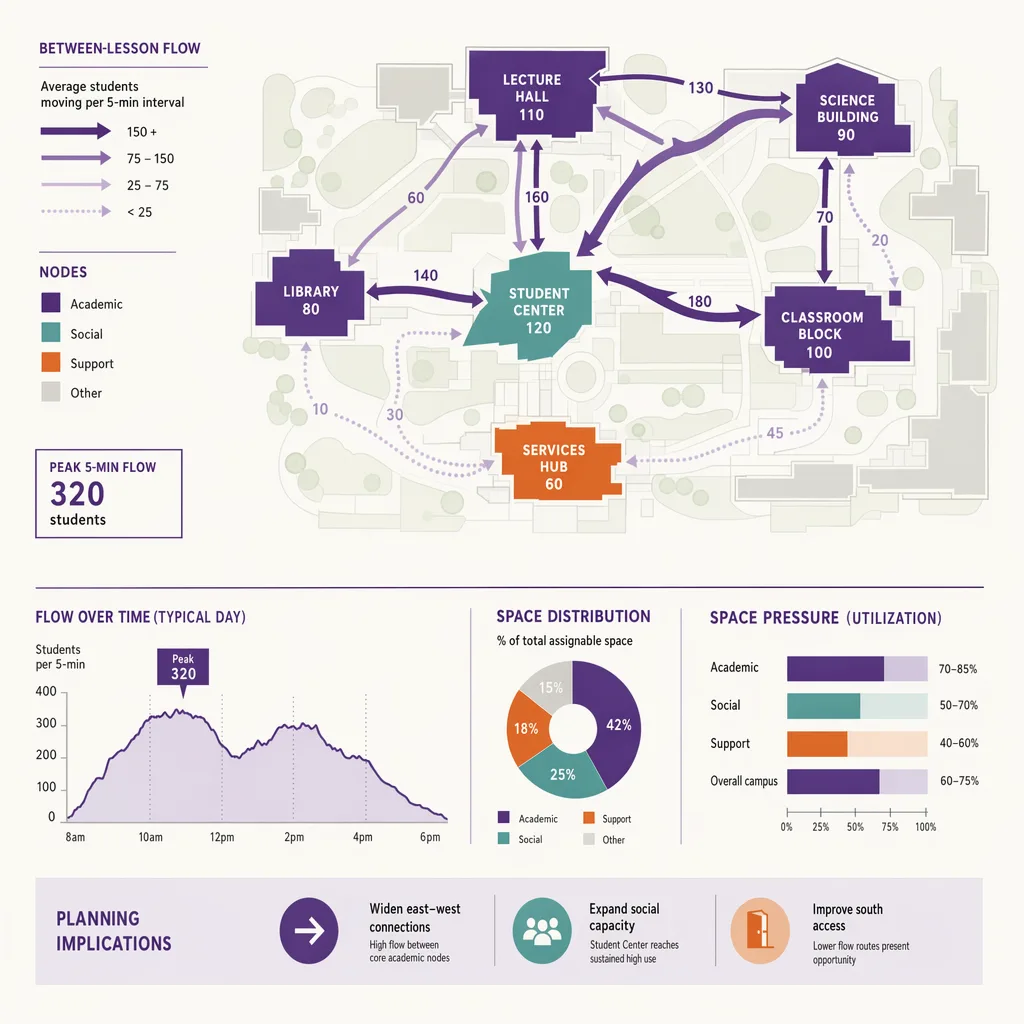
Campuses move in pulses. At a school, the entire population changes rooms in the same five minutes between lessons, and certain corridors and stairwells carry far more of that load than others. At a university, the gaps between lectures send a wave through the main entrances and circulation spaces. Counting at doors and key thresholds shows where those pulses concentrate, which matters for everything from where to put a member of staff on duty to whether a corridor or entrance is a pinch point that a refurbishment should widen.
The same flow data informs entrance and security decisions, again without identifying anyone. Knowing that a side entrance carries a third of the morning arrival, or that a particular door is barely used and could be reallocated, is a planning input that a swipe-card log, which only sees the doors that have readers, cannot give you for the whole estate.
The pulse pattern also surfaces problems that only appear at scale and at the wrong moment. A corridor that is comfortable at any single point in the day can become a genuine crush in the five minutes a whole year-group changes rooms, and a single staircase that quietly carries far more than its share of that movement is both a duty-of-care concern and a refurbishment priority. Because the counter records the timing of the pulse and not the identity of anyone in it, the estates team can see exactly where and when the load concentrates, which turns "that corridor feels too busy at changeover" into a measured case for widening it, adding a second route, or simply staggering the timetable so the pulse spreads across two minutes instead of one.
Counting around minors responsibly: camera-free, no identity, no PII at capture
This is the point that has to be unambiguous on a school campus. Counting pupils, especially minors, raises an obvious and reasonable concern, and the right answer is not that personal data gets stripped out after the fact. The right answer is that nothing personal is captured in the first place.
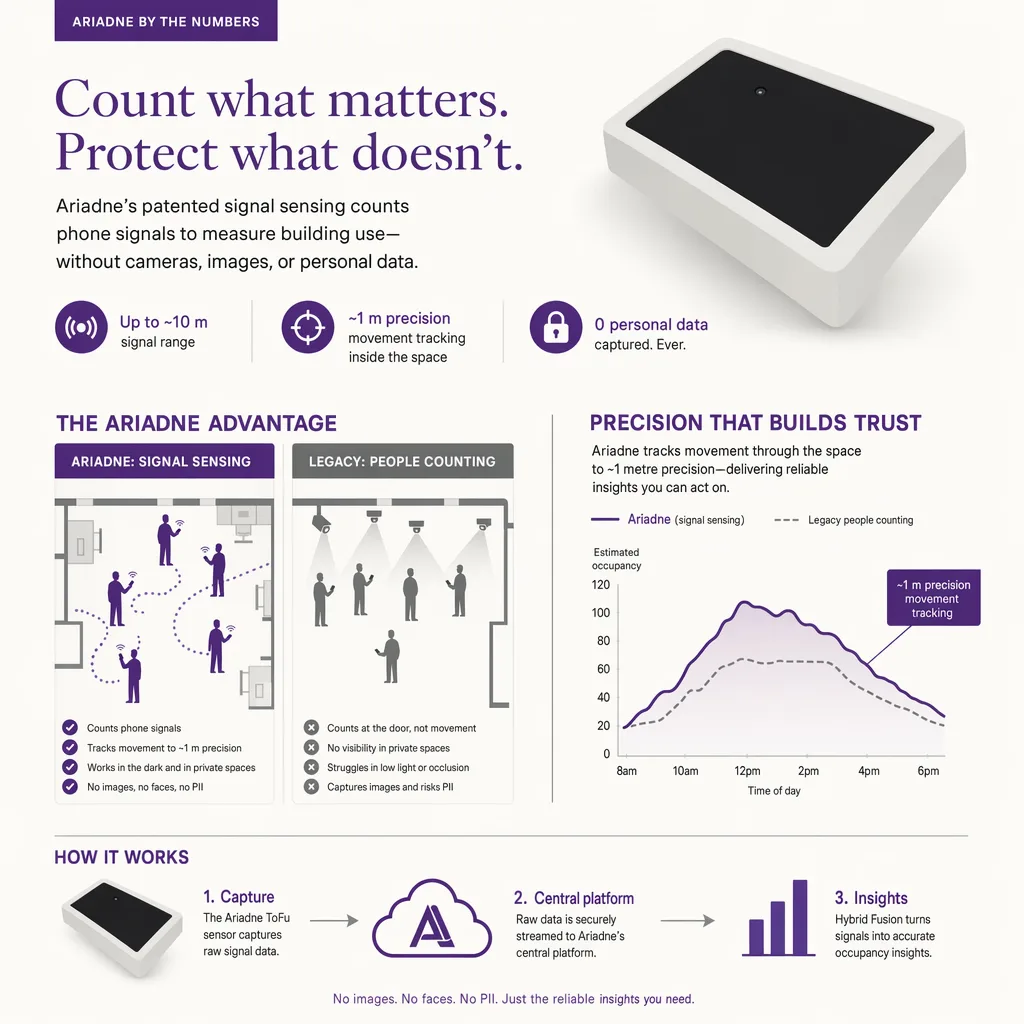
Ariadne measures this with Hybrid Fusion, its patented camera-free method. Time-of-Flight depth sensing counts every visitor at the entrances, capturing geometry rather than images, while patented phone signal sensing follows movement through the interior, detecting the signals a phone emits even in airplane mode, and tracks that movement to about one-metre precision. The sensor streams both feeds to Ariadne, where Hybrid Fusion combines them into one trajectory per visit and computes counts, dwell, and paths. The streams carry no identifier: no MAC address, no device ID, no biometric data, and no camera is involved. Identifiers are stored only when a visitor explicitly opts in, which keeps the method GDPR-friendly and outside biometric territory.
For a school this is the whole point. There are no cameras pointed at children, no faces recorded, and no way to single out a pupil. The system measures that a space was busy, not who was in it. That is a fundamentally different thing from tracking students, and the distinction matters: this is a non-biometric method that produces building-use data, not a monitoring tool aimed at individuals. It is the same reason institutions reach for counting without cameras in any setting where the people being counted have a strong and legitimate expectation of privacy.
This distinction is also what makes the project approvable. A school proposing camera-based monitoring of pupils faces a hard conversation with governors, parents, and a data protection officer, and rightly so. A school proposing to measure how full its buildings are, with a method that records no image and no identifier and cannot single out a child, is making a facilities decision rather than a surveillance one. The framing should stay there throughout: the deliverable is a building-use curve for the estates team, never a record of where any individual pupil went. If a phrase in a proposal or a parent letter could be read as "we are tracking students," it has misdescribed what the system does, and the correction is to describe the building, not the people.
Cleaning, energy, and space-planning decisions
The payoff is operational. Cleaning rounds can follow the rooms that were actually used and the hours they were used, rather than a fixed rota that services empty spaces and skips busy ones. Energy and heating can be scheduled to real occupancy, which on a large estate is one of the bigger controllable costs there is, by closing or setting back buildings that the data shows are empty at the end of the day.
Space planning is the longer game. When a campus argues for a new building or a refurbishment, the strongest evidence is a measured demand curve: this study space runs at capacity from mid-morning, that lecture block is half-empty, this room booked daily is rarely occupied. That utilization data turns a capital case from an assertion into a measurement, and often reveals that the cheaper answer is repurposing space that already exists rather than building more.
How an estates manager actually uses it
The day-to-day user is the estates or facilities manager, and the honest version of their workflow is that they do not watch a live dashboard all day. They use the data at three cadences. Weekly, they reconcile the cleaning rota against actual use, moving effort off the rooms that sat empty and onto the study space that ran hot every evening. Termly, they set heating and opening hours against the curve the term actually produced, which differs from the timetable's intent and differs again between term, exam season, and vacation. Annually, they take the demand curves into the capital and space-planning meeting, where the argument shifts from competing assertions about which buildings are under pressure to a ranked, measured list.
The single most common win is the booked-but-empty room. Every campus has them, and they distort the space-planning model because a room on a booking system reads as occupied capacity. When the counter shows that a regularly booked room is rarely entered, the estates manager has two cheap moves before any expensive one: release the booking so the space can be reallocated, or investigate why the booking persists. That alone can defer a "we need more rooms" conversation that would otherwise have led to a capital request, which is the kind of result that justifies the system to a finance committee far faster than the energy savings do.
FAQ
Does counting foot traffic on a school campus mean tracking students?
No. A camera-free counter measures that a space was busy, not who was in it. There is no footage, no identifier, and no way to single out a pupil, so it is building-use measurement rather than tracking of individuals.
Is it lawful to count pupils, including minors?
A counter that captures no personal data, no images, and no identifier collects nothing that identifies a child, which keeps it outside the parts of data protection law that govern personal data. As with any deployment in a school, confirm the specifics with your own data protection officer.
Can it tell the difference between a staff member, a student, and a visitor?
Not as individuals. It counts people crossing a threshold and separates the data by location and time, so the pattern of when and where a space is busy is clear, but it does not label anyone by role.
What can a campus actually decide with this data?
Cleaning rounds matched to real use, heating and opening hours set to measured occupancy, and a capital case for new or repurposed space backed by an actual demand curve rather than the timetable's assumptions.
How is this different from swipe-card access data?
Swipe data only covers doors with readers and only people who badge in, and it ties the entry to a named person. Foot-traffic counting covers any entrance, counts everyone including visitors, and records no identity, which makes it both broader and less intrusive for estate-wide planning.
Does it help with exam-season planning specifically?
Yes, and that is often where the data earns its place. Exam season produces a study-space demand curve that bears little relation to the term-time timetable, and counting shows exactly when and where students cluster, which is the evidence for extending library hours or opening overflow study space for the weeks it is genuinely needed rather than as a blanket policy.
---


