
Most places of worship still count attendance the way they did fifty years ago: a steward stands near the door with a clicker, or someone scans the room mid-service and writes down a guess. On a quiet weekday that is fine. On a festival day, a packed funeral, or a service that spills into the side aisles, the guess is off by a wide margin, and the person doing it is a volunteer who would rather be somewhere else. Meanwhile the people who actually need the number, the trustees writing a grant application, the diocese reviewing which buildings to keep open, the insurer asking about capacity, want something more reliable than a feeling.
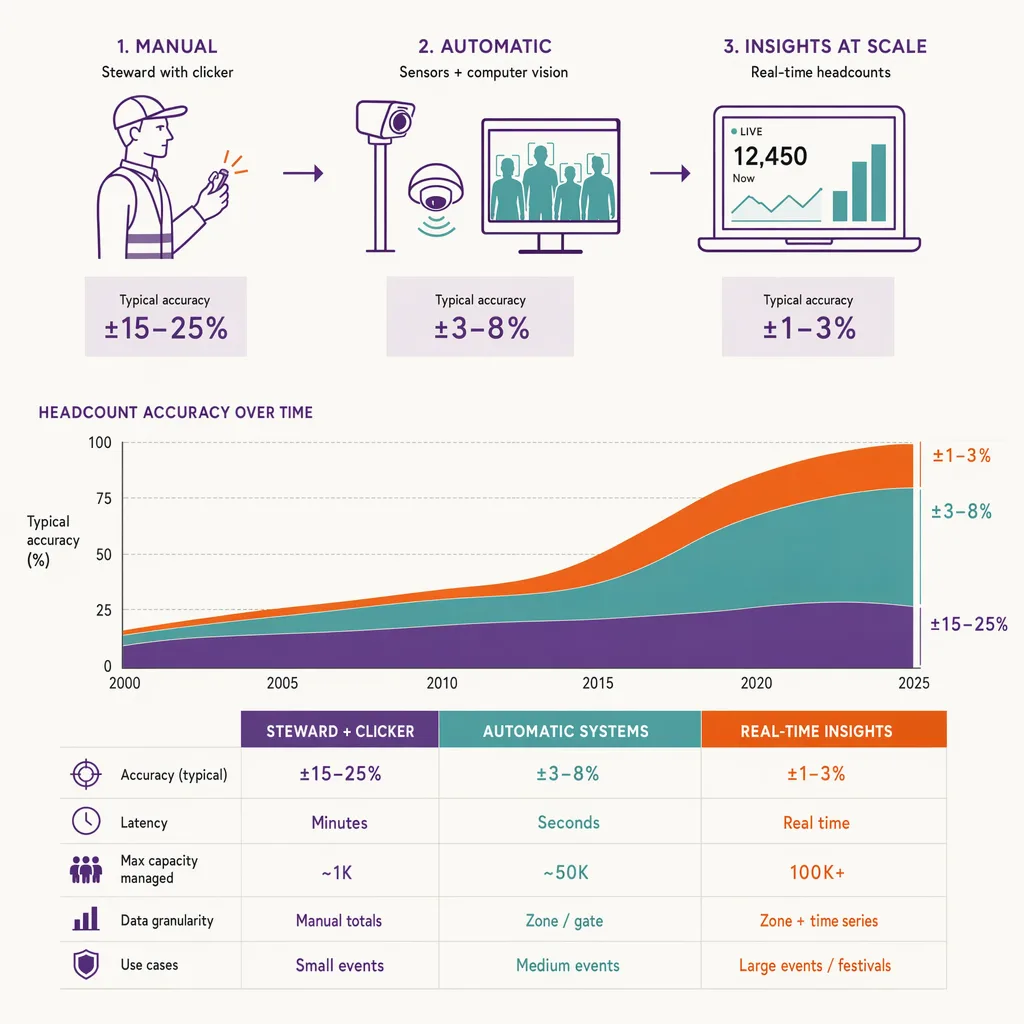
This is a small, awkward measurement problem with real consequences. A door-mounted counter solves it quietly. This guide covers how attendance counting works at a place of worship, why a camera is the wrong tool for a sacred space, and how the data feeds the planning, energy, and funding decisions that congregations actually face.
How do you count attendance at a place of worship?
Most places of worship still count attendance by a steward's estimate or a clicker at the door, which undercounts on busy days and burns volunteer time. A door-mounted counter records every entry and exit automatically, giving an accurate figure for each service, festival, and weekday opening. Because it counts at the threshold without a camera and holds no record of who attended, it gives a reliable headcount for planning and funding while respecting the quiet, personal nature of attendance.
The shift is from a person remembering to count to a sensor that always does. The output is a number per service and a pattern over weeks, not a one-off tally that depends on who was on the door that day.
The worship-specific pain point: manual counts are inaccurate and intrusive, yet funders want real numbers
The tension here is particular to worship. On one side, the people running the building are increasingly asked for hard attendance figures. Denominational bodies track it to decide where to invest clergy and money. Grant funders for heritage repairs want evidence the building is used. Diocesan and trust reviews of which churches to keep open lean on attendance trends. None of those audiences accepts "it felt busy."
On the other side, counting people as they come to pray is sensitive in a way that counting shoppers is not. Nobody wants a turnstile at the door of their church, a camera pointed at the congregation, or a sense that attendance is being surveilled. A festival service might draw four times the regular congregation, and a clicker-wielding steward will lose count somewhere in the rush. The result is that the most important days, the ones the funders care about most, are the ones counted worst.
There is also a quieter problem with the manual method: it is inconsistent from week to week and from counter to counter. One steward counts heads at the start of the service and stops. Another tries to add the latecomers and forgets to. A third counts only the nave and misses the side chapel and the gallery. When the figure feeds a multi-year trend that a diocese or a trust will read, that week-to-week noise can swamp the actual signal, so a real decline looks like a wobble and a real recovery goes unnoticed. The value of a fixed sensor is not only accuracy on the day but consistency across the years, which is what makes a trend line trustworthy.
A counter at the threshold resolves both sides. It is accurate on the busy day, because it does not get tired or distracted, and it is unobtrusive, because it sits above the door and records nothing about who walked through.
Per-service and festival headcounts, automatically
The core output is a clean count for every gathering. A regular Sunday or Friday service, a weekday mass, a wedding, a funeral, a christening, and the major festivals all get their own figure, separated by the time they happen rather than estimated as one weekly number. Entries and exits are both recorded, so a service that empties and refills for a second sitting is counted as two congregations, not one.
Over a year, that builds the trend line a trustee actually needs: are regular numbers holding, growing, or slipping; how much larger is Christmas or Eid or a patronal festival than an ordinary week; which weekday openings draw enough people to justify the heating. A real-time count of who is in the building also matters on the rare days a place of worship has to manage a capacity limit, for a popular carol service or a televised funeral.
The separation by time is what turns a single number into something a committee can reason about. A weekly total that lumps the Sunday morning service, the said early service, and the evening gathering into one figure hides the most useful fact, which is which of those is growing and which is fading. A building deciding whether to keep its second Sunday service, or whether the midweek said service is worth a priest's time, needs each gathering counted on its own. Once it is, a pattern that the clergy half-suspected becomes a number they can act on: the early service has quietly halved over two years, the family service has doubled, and the resourcing should follow.
Weekday and visitor use of a heritage building
Many historic places of worship are open far beyond their services. Tourists visit the building, people come in to light a candle or sit quietly, concerts and community groups use the nave on weekday evenings. That use is real, it carries a cost in heating and stewarding, and it is almost never measured. The same door counter that records the Sunday congregation records the Tuesday-afternoon visitors, which turns a vague sense of "we get a lot of tourists" into a number you can put in a heritage grant application or a case for a paid welcomer.
This is where worship attendance counting overlaps with the wider world of footfall counting for institutions, where a cathedral or a famous parish church behaves a lot like a museum. The difference is that the congregation and the visitors share one door, and you usually want to see both streams rather than only the paying or registering ones.
For a building that takes voluntary donations from visitors rather than an admission charge, the visitor count is also the only honest read on conversion. A famous parish church might log a known sum from its donation boxes and have no idea whether that came from a hundred visitors or a thousand. Counting the door turns the donation total into a per-visitor figure, which is the number that tells a fundraising committee whether the problem is too few visitors or too few of them giving, and whether a clearer ask at the door would change either.
Why camera-free, no-record counting fits a sacred space
A sacred space is exactly the kind of place where a camera over the door feels wrong, and where a system that builds a record of who attended would be a genuine intrusion. Attendance at worship is personal. People should be able to come and go without being filmed or logged.
Ariadne measures this with Hybrid Fusion, its patented camera-free method. Time-of-Flight depth sensing counts every visitor at the entrances, capturing geometry rather than images, while patented phone signal sensing follows movement through the interior, detecting the signals a phone emits even in airplane mode, and tracks that movement to about one-metre precision. The sensor streams both feeds to Ariadne, where Hybrid Fusion combines them into one trajectory per visit and computes counts, dwell, and paths. The streams carry no identifier: no MAC address, no device ID, no biometric data, and no camera is involved. Identifiers are stored only when a visitor explicitly opts in, which keeps the method GDPR-friendly and outside biometric territory.
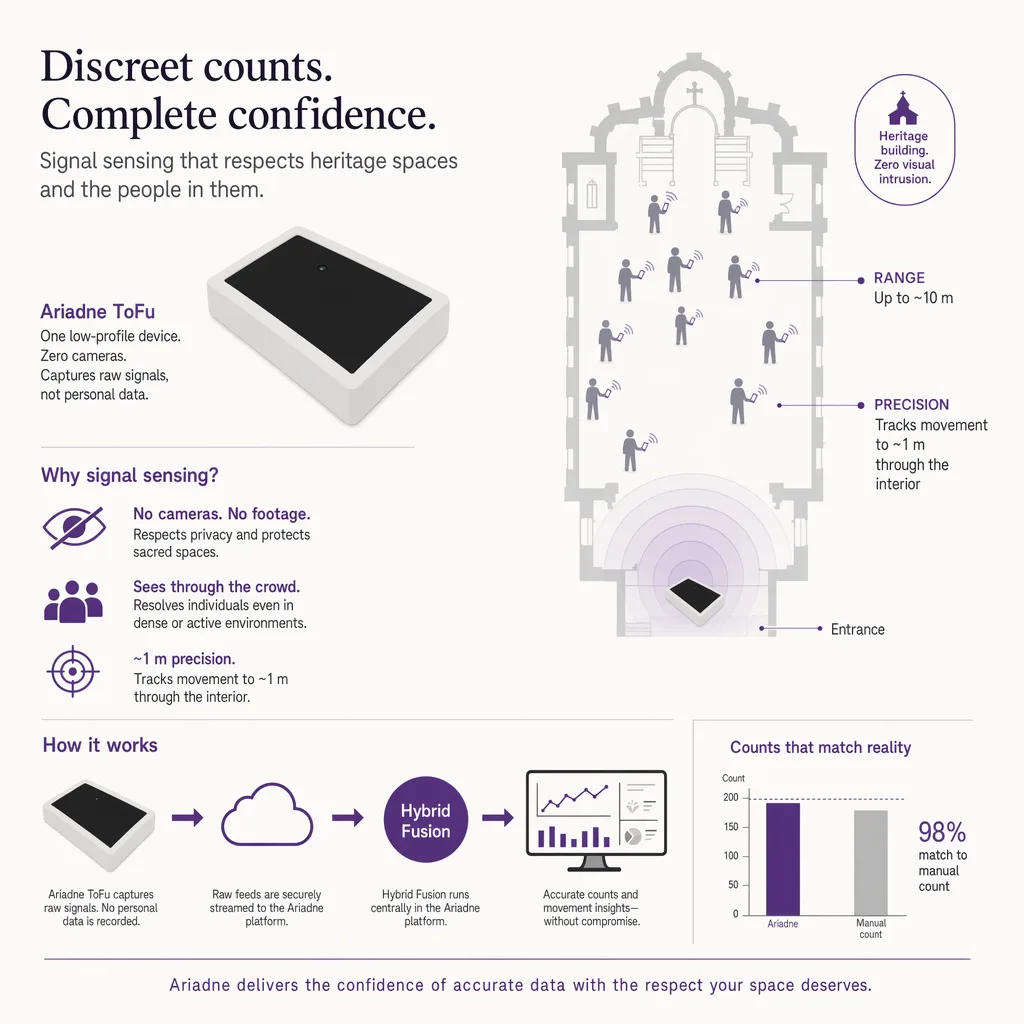
In plain terms: the counter sees that a person crossed the threshold, not who they were. There is no footage of the congregation, no list of attendees, and nothing personal to store, lose, or hand over. For the same reason, the method sits firmly in the non-biometric category, with no record of who attended, which is the honest answer to the question a vestry or mosque committee will ask first. The hardware itself is a small unit at the door rather than a camera on a pole; in a listed or historic building, discreet mounting at the entrance matters as much as the data, and the door sensor is designed to be unobtrusive.
The no-record property also makes the governance conversation short, which matters when the people approving the install are volunteers giving their evenings to a parochial church council or a mosque committee rather than a procurement team. There is no attendee database to write a policy around, no retention schedule to argue over, and nothing a subject access request could ever return, because nothing about an individual was collected. A committee that would balk at a system requiring a privacy notice on the door and a data-protection sign-off can usually approve a counter that holds no personal data at all in a single meeting.
Using the data for staffing, energy, and grant reporting
Once the counts are reliable, they answer the practical questions that keep a place of worship running.
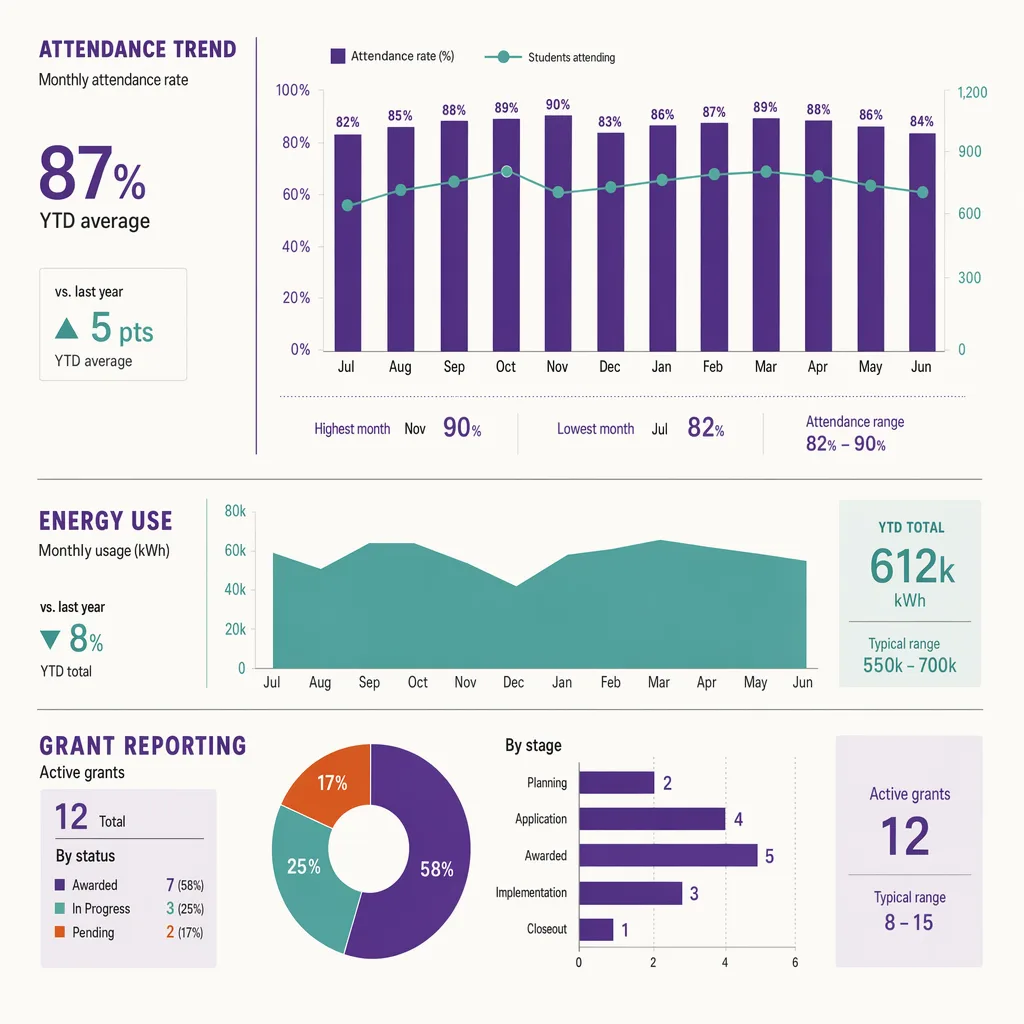
Energy is the immediate one. Heating a large stone building is the biggest controllable cost most congregations have, and attendance data shows which services and openings actually draw enough people to justify it, so the heating follows the congregation rather than the calendar. Staffing and volunteering follow the same logic: the festival that needs three welcomers and two extra stewards is the one the data already flagged as four times a normal week.
Then there is reporting. A grant application for roof repairs, a faculty request to a diocese, an insurance review, and a denominational return all ask, in different words, how much the building is used. An exported attendance trend answers that with evidence rather than estimate. None of this requires inventing a target; it requires knowing the real number, which until now most congregations have not had.
How a churchwarden or facilities lead actually uses it
In practice the data lands with one or two people: a churchwarden, a parish administrator, a mosque or temple facilities lead. The realistic weekly use is small and that is the point. They glance at the past week's figures to sanity-check that nothing odd happened, the heating system did not stay on for an empty building, a one-off event drew the numbers expected. The real work is monthly and annual. Once a quarter they export the trend for the standing committee, and the conversation moves from "it feels like we are busier since the new family service" to a line on a chart that either supports that or does not.
The energy decision is where the counter usually pays for itself first. A facilities lead with an attendance curve can set the heating to come up before the services that genuinely fill the building and stay down for the sparse midweek opening, rather than running a blanket schedule that warms a near-empty nave for hours. Over a heating season in a large masonry building, even a modest tightening of that schedule is a meaningful sum, and it is the kind of saving a treasurer can point to when the install cost comes up at the next meeting. The grant and faculty reporting is the slower-burning value: when a heritage repair bid asks for evidence of community use, an exported two-year curve showing services, concerts, and weekday visitors is far stronger than the estimate most applications fall back on.
FAQ
Is it appropriate to count people at a place of worship?
Counting attendance is long-standing practice; the concern is usually about how it is done. A camera-free counter at the door records that someone entered, not who they were, and keeps no footage or attendee list, so it answers the funding and planning need without surveilling the congregation.
Will a counter work for a festival service that is far busier than usual?
Yes, and that is where it helps most. A volunteer with a clicker loses count in a crowd, while a door counter records every entry and exit at the same accuracy on a packed festival day as on a quiet weekday.
Can it tell visitors apart from the regular congregation?
It separates counts by time, so a Sunday service, a weekday opening, and an evening concert each get their own figure. It does not identify individuals, so it cannot label a specific person as a tourist or a member, but the timing pattern usually makes the two streams clear.
Does counting attendance this way comply with data protection law?
A camera-free counter that captures no identifier and holds no record of who attended collects no personal data, which keeps it outside the parts of GDPR that govern identifiable information. Confirm the specifics with your own data protection adviser before deploying.
What happens on the days the building is used for something other than worship?
The counter does not know the difference between a service and a concert; it simply records entries and exits by time. Because each gathering is separated by when it happens, a weekday concert, a community group, or a school visit each show up as their own figure, which is exactly the weekday-use number a heritage funder asks for.
Can one system cover a building with several entrances?
Yes. Each used entrance gets its own sensor, and the counts combine into a single figure for the building so a side door and a main door are not double-counted against each other. For a cathedral or a large church with multiple ways in, counting every threshold is what makes the total trustworthy rather than an undercount from the one door that happened to be instrumented.
---


