
The economics of a petrol station have quietly inverted. Fuel still moves the most volume, but the margin on it is thin and getting thinner, squeezed between wholesale prices and price-board competition down the road. The profit increasingly lives inside the shop: the coffee, the meal deal, the snacks, the top-up groceries that a driver buys on impulse while they are already on the forecourt. Operators know this. What they cannot see is the one number that connects the two halves of the site: how many of the people who refuelled actually walked into the store.
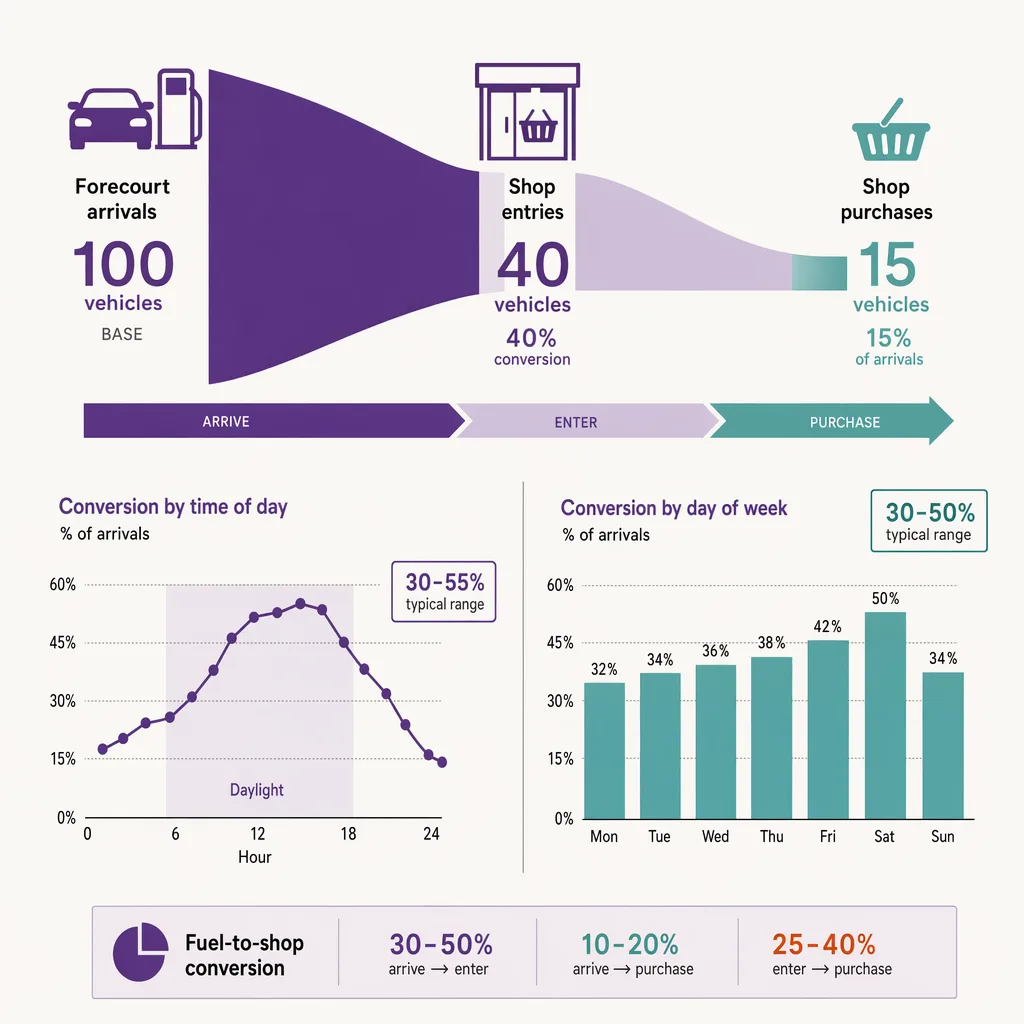
Pump data is blind to it. The pumps know litres sold and card transactions; they have no idea whether a driver paid at the pump and drove off, or wandered in for a coffee and left with a basket. The till knows shop sales but not how many people passed the door without buying. Between the forecourt and the shop there is a conversion that nobody is measuring, and it is the conversion the whole business model now depends on. Forecourt counting closes that gap. This guide covers what it measures, why outdoor 24-hour counting is its own challenge, and how the data runs a small site.
Why count footfall on a petrol station forecourt?
The money on a modern forecourt is increasingly in the shop, not the fuel, and pump transactions cannot tell you how many drivers actually walked into the store. Forecourt counting measures the fuel-to-shop conversion: how many people who refuelled crossed the threshold, and how many came for the shop alone. That shows whether a meal-deal or coffee offer pulls drivers inside, when to put a second person on the till, and how a site compares to others on shop capture rather than fuel volume.
The metric that matters is shop capture, not fuel volume. Two sites can sell identical litres and earn very different money because one converts far more refuelling drivers into shop customers, and until you count the door you cannot tell them apart.
The forecourt-specific pain point: fuel margin is thin, the shop is the profit, and pump data is blind to it
A forecourt operator runs two businesses on one plot, and only one of them is measured properly. The fuel side is instrumented to the litre: pump throughput, wet stock, margin per litre. The shop side has till data, but the till only sees the people who bought something, not the people who came in and did not, and crucially neither system sees the handoff between the two. The driver who refuels and drives off, and the driver who refuels and comes in for a sandwich, look identical to the pump. One is pure thin-margin fuel; the other is the high-margin shop sale the site exists to capture.
That blind spot makes the most important decisions guesswork. Does the new coffee machine actually pull more drivers inside, or just serve the ones who were coming anyway? Did moving the meal deal to the window change anything? Is this site underperforming on shop sales because of low traffic or poor conversion? Without counting the people who cross from forecourt to shop, the operator is optimising the profitable half of the business on instinct while measuring the thin-margin half to three decimal places.
The blind spot also distorts how head office reads the estate, which compounds the problem at scale. A regional manager comparing sites on fuel volume and shop turnover will rank a high-traffic site with weak conversion above a quieter site that converts brilliantly, because the raw shop turnover is higher. So the genuinely well-run small site gets less investment and attention than the busy site that is leaving money at the door, and the lesson that actually drives profit, get drivers from the pump into the shop, never gets surfaced because no number in the standard report captures it. Counting the door is what lets the comparison be made on the metric that matters rather than the one that is merely easy to read off the existing systems.
Measuring fuel-to-shop conversion
The core measurement is the bridge the pump and the till cannot build between them. A counter at the shop door records everyone who enters; the pumps record refuelling events; the till records transactions. Together they let an operator separate the streams that matter: drivers who refuelled and came in, drivers who refuelled and left, and the shop-only customers who never touched a pump, which on many sites is a large and growing group as forecourts become local convenience stores in their own right.
The headline ratio is fuel-to-shop conversion: of the people who refuelled, how many walked into the shop. That single number tells the operator whether the site's profit engine is firing. The same conversion-rate thinking retail uses on entries applies here, with the twist that the forecourt has two front doors, the pump and the store, and the interesting metric is the flow between them. It is the forecourt version of capture rate: what share of the people physically on your site you actually pull through the shop door.
The growing shop-only stream is worth measuring in its own right, because it changes what the site is. As forecourts become the local convenience store for their neighbourhood, a substantial share of shop customers arrive on foot or park without ever using a pump, and that group responds to completely different levers than the refuelling driver. The fuel customer is a captive audience to be converted with a well-placed coffee offer; the shop-only customer is a convenience shopper to be won on range, price, and hours, the same as any small store. An operator who cannot see the two streams separately will tune the shop for one and accidentally neglect the other, which is why the door count matters even on sites where fuel still dominates the forecourt.
Outdoor counting at the shop door: weather, glare, and 24-hour operation
A forecourt is one of the harder places to count. The shop entrance sits in an outdoor or semi-outdoor environment, exposed to weather and to direct sun that washes across the glass at certain hours, and many sites run 24 hours, which means counting has to be as accurate at three in the morning as at three in the afternoon. A counting method that depends on good ambient light fails exactly during the night-shift hours when a single member of staff most needs to know whether anyone is on the forecourt.
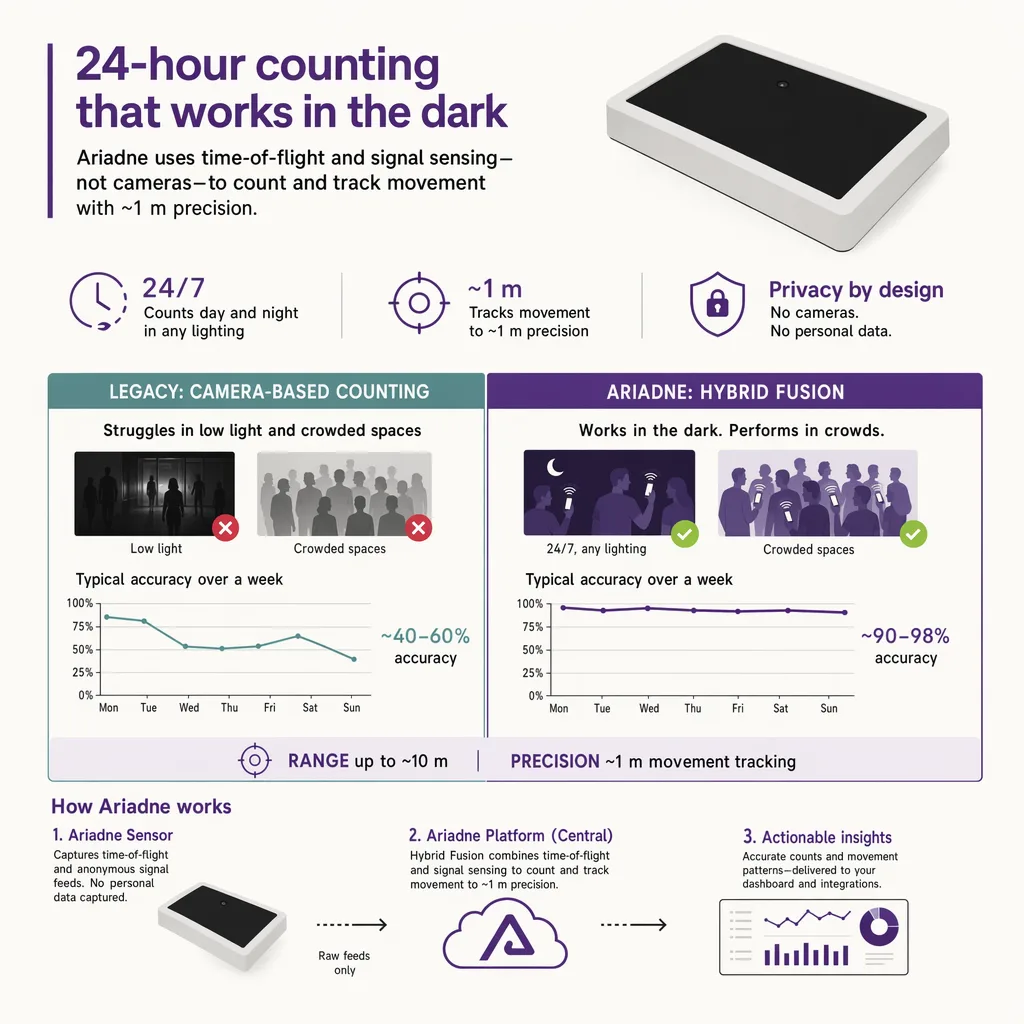
Ariadne measures this with Hybrid Fusion, its patented camera-free method. Time-of-Flight depth sensing counts every visitor at the entrances, capturing geometry rather than images, while patented phone signal sensing follows movement through the interior, detecting the signals a phone emits even in airplane mode, and tracks that movement to about one-metre precision. The sensor streams both feeds to Ariadne, where Hybrid Fusion combines them into one trajectory per visit and computes counts, dwell, and paths. The streams carry no identifier: no MAC address, no device ID, no biometric data, and no camera is involved. Identifiers are stored only when a visitor explicitly opts in, which keeps the method GDPR-friendly and outside biometric territory.
The relevant property for a forecourt is that the depth sensing brings its own light. Because it fires an infrared pulse and measures the return rather than reading an ambient image, it counts in darkness as readily as in daylight, which is why counting in low light is not a problem for it the way it is for a camera. Outdoor and 24-hour deployment still requires hardware rated for the environment, so check the environmental rating for the specific site rather than assuming any unit copes outside.
The night-shift accuracy is not a niche concern; on a 24-hour site it is half the operating day and a disproportionate share of both the staffing cost and the risk. A method that degrades after dark would be blind precisely when a lone overnight worker most needs to know whether someone is on the forecourt, and would undercount the overnight trade that decides whether running 24 hours is worth it at all. Because the depth sensing supplies its own illumination, the overnight count is as trustworthy as the daytime one, which means the data can answer the question many small sites quietly carry: do the small hours earn their keep, or should the site close overnight and save the wage and the lone-working exposure.
Staffing a small site to traffic, not the clock
A forecourt shop usually runs on one or two people, and that thin staffing is precisely why getting it right matters. Put a second person on at the wrong hour and the labour cost eats the shop margin you were trying to grow; leave a single person alone when a coffee-and-commute rush hits and you lose sales to a queue and create a lone-working risk at the same time. The clock-based rota that most small sites default to ignores the actual traffic shape.
Counting the door gives that shape. The morning commute spike, the lunch dip or surge depending on the site's location, the evening top-up run, and the genuinely quiet overnight stretch all show up as a measured curve. Staffing the till to that curve, the same staffing-to-traffic logic any small format uses, puts the second person on for the rush and accepts the single cover when it is truly dead, which protects both the margin and the lone worker. It is the small-site version of the convenience-store counting problem, with the added wrinkle that the forecourt's traffic is shaped by the road and the commute as much as by the shop.
The traffic shape on a forecourt is also more location-specific than almost any other small format, which is why a chain cannot impose one rota across sites. A commuter-route site peaks hard at the morning and evening rush and is dead in between; a motorway services site runs steadily through the day with no clear commute pattern; a residential-area site behaves like a neighbourhood convenience store with an evening top-up peak. The same brand, the same shop layout, completely different curves, which means the only honest way to staff each one is against its own measured door rather than a head-office template. A manager who has the curve for their specific site can defend the second-person hours to a regional manager with data instead of pleading, which tends to be where the staffing argument is actually won or lost.
Grading a forecourt estate on shop capture
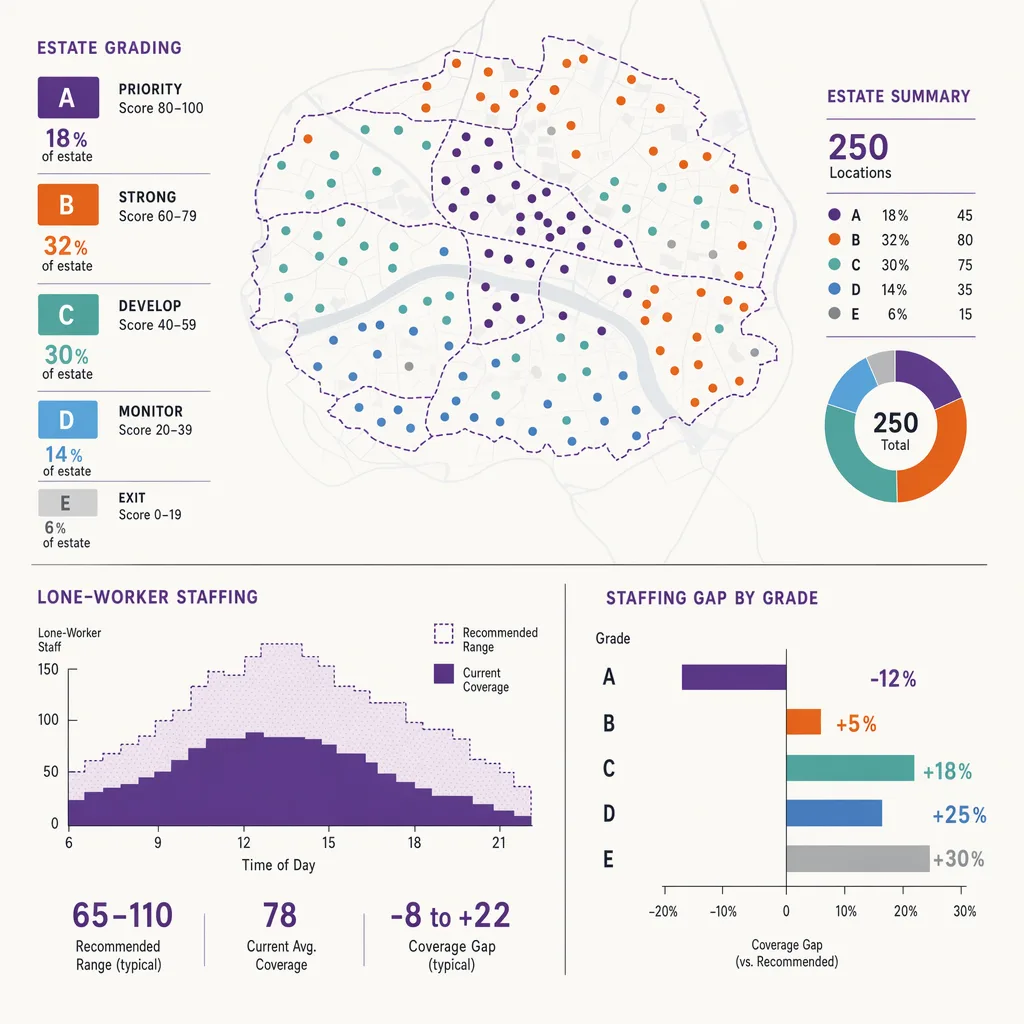
For an operator running many sites, footfall counting changes how the estate is compared. Ranking forecourts by fuel volume rewards the ones on the busiest roads and tells you nothing about how well each runs its shop. Ranking them by shop capture, the share of forecourt traffic converted into shop visits, surfaces the sites that are genuinely good at the profitable half of the business and the ones leaving money at the door despite healthy fuel sales.
That grading is fair because it normalises for traffic. A quiet rural site that converts a high share of its drivers into the shop may be a better-run operation than a motorway site with huge fuel volume and weak capture, and only counting reveals it. The strong performers become the template, the people-counting-to-action playbook applied across the estate, and the laggards get a measured target rather than a vague instruction to sell more coffee.
FAQ
What does forecourt counting measure that pump data does not?
Pump data sees litres and fuel transactions. Forecourt counting sees how many people walked into the shop, including drivers who refuelled and came in, drivers who refuelled and left, and shop-only visitors. That fuel-to-shop conversion is invisible to the pumps.
Does the counter work outdoors and at night?
The depth sensing supplies its own infrared light, so it counts in darkness as well as daylight, which suits a 24-hour site. Outdoor deployment still needs hardware rated for the environment, so confirm the environmental rating for your specific site.
Can it tell the difference between a fuel customer and a shop-only customer?
Not by identifying anyone. By combining the door count with pump and till data over the same period, an operator can separate the streams, refuel-and-enter, refuel-and-leave, and shop-only, without recording who any individual is.
Is this useful for a single site or only a chain?
Both. A single site uses it to staff the till to traffic and test whether shop offers pull drivers in. A chain also uses it to grade sites fairly on shop capture rather than fuel volume.
How do I tell whether a new coffee or meal-deal offer actually worked?
Read the fuel-to-shop conversion before and after the change, over comparable periods, rather than the raw shop turnover. Turnover can rise simply because traffic rose; conversion rising means more of the drivers who were already on the forecourt came inside, which is the effect the offer was supposed to have.
Can the data tell me whether running 24 hours is worth it?
It gives you the missing half of that decision. Pump and till data show overnight sales, but only an accurate overnight door count, which depth sensing provides in the dark, shows how much real footfall the small hours draw, so you can weigh the overnight trade against the wage cost and the lone-working risk.
---


