
A mall reopens after a two-year redevelopment, the launch weekend is packed, and the press release calls it a success. Six months later the crowds have thinned and nobody is quite sure whether the project moved the needle or just threw a good party. This is the recurring problem with redevelopment: the money is committed years before anyone can say whether the footfall justified it, and the reopening spike is a terrible proxy for the answer.
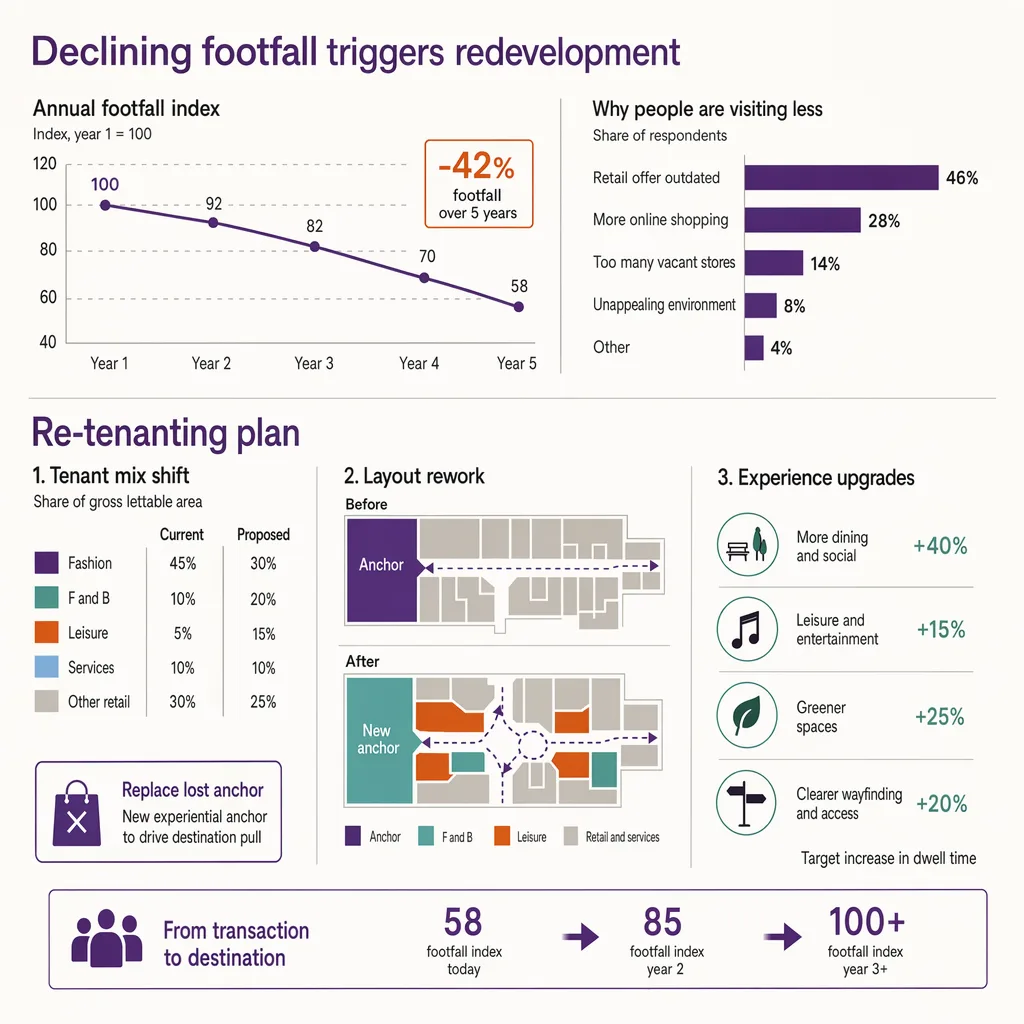
Proving that a repositioning worked is a measurement problem, not a marketing one, and it is a harder measurement than counting visits on an ordinary Tuesday. This walks through the redevelopment plays landlords actually run, the method that produces a defensible before-and-after answer, and the mistakes that make a mediocre project look like a triumph. It does not name a specific project result, because a credible method is the transferable thing here, not somebody else's press number.
The stakes are high enough that the measurement deserves the rigor. A center redevelopment can run into the tens or hundreds of millions, take years, and disrupt trading the entire time. The decision to commit that capital is usually made on a business case built from projected footfall and the spend it should unlock, and the same footfall logic that justified the spend is what should later hold the project to account. A redevelopment that cannot show a defensible footfall lift is one where nobody can honestly say the capital worked, which is a hard position to be in at the next valuation or the next round of funding.
How do you measure whether a mall redevelopment increased footfall?
You measure it the way you would test any intervention: establish a clean baseline before work starts, hold a control where possible, then compare like-for-like visits after reopening, correcting for seasonality and for the construction-period dip. The trap is comparing a busy reopening week to a quiet pre-works week and calling it success. A credible redevelopment case uses entry counts at consistent points over comparable periods, separates genuinely new draw from visits simply cannibalized from elsewhere in the center, and reports sustained footfall months after the opening buzz has faded, not the launch spike.
The redevelopment plays landlords run
Redevelopment is not one thing. The measurement question changes with the play, so it helps to name them.
Anchor backfill
The narrowest play: a full-line department store goes dark and the landlord fills the box with something else, often subdividing it. This is the most studied redevelopment move, and it sits at the boundary between whole-center repositioning and single-tenant replacement. The measurement discipline for the box itself is covered in the anchor-replacement playbook; at center scale, the question becomes whether the new occupant lifted the whole property or just filled a hole.
Mixed-use conversion
The most common answer to a shrinking retail box: convert part of the center to non-retail use, residential, office, medical, hotel, or civic space, so the property draws footfall it never had as a pure mall. This changes what "footfall" even means, because the residents and workers now on site are a captive, high-frequency base rather than discretionary shoppers. The economics of that shift are in mixed-use conversion, and the measurement has to separate the new resident-and-worker traffic from genuine retail draw.
Experiential reinvention
Rebuilding the tenant mix around dining, entertainment, leisure, and services rather than pure comparison retail. The bet is on dwell: keep people on site longer and spend follows. Measuring this play means watching dwell time as closely as entries, since the whole point is a longer visit rather than simply more visits.
Partial demolition and rebuild
The most capital-intensive play: knock down the failing portion, often a dead department-store wing, and rebuild at a different scale or footprint. Here the baseline is genuinely disrupted, because the physical center after is not the center before, and the measurement has to acknowledge that you are comparing two different properties, not the same property at two dates.
Most real projects blend several of these at once, which is exactly what makes the measurement hard. A single redevelopment might backfill one dark anchor with a food hall, convert a second into apartments, and open up the corridor between them to feel more like a lifestyle center. Each element moves footfall in its own way and on its own timeline, and the reopening lumps them together into one headline number. Untangling which part of the lift came from which play is the difference between a report that guides the next project and one that just declares victory.
The redevelopment business case, and why footfall is the accountability metric
Before the first hoarding goes up, a redevelopment is sold internally and to lenders on a projection: this much capital buys this much additional footfall, which converts to this much additional tenant sales, which supports this much additional rent and this much uplift in the center's value. Footfall sits at the front of that chain. It is the leading indicator that everything downstream depends on, and it is measurable long before the rent and valuation effects show up.
That is why footfall, measured properly, is the natural accountability metric for a redevelopment. Sales data arrives late, is often self-reported by tenants, and is muddied by pricing and promotion. Valuation moves on a lag and on factors well beyond the center. Footfall is the earliest clean signal that the physical changes are pulling the people the business case promised. A landlord who measured the pre-works baseline honestly can, within a year of reopening, say with evidence whether the project is tracking to the case or falling short, while there is still time to adjust the tenant mix, the marketing, or the leasing strategy. Without that measurement, the first hard read on the investment is the next valuation, which is far too late to change anything.
The measurement method that holds up
A redevelopment footfall case that survives scrutiny rests on five disciplines.
Establish a clean baseline before work starts. Capture entry counts at consistent measurement points across a full year before construction, so you have the real seasonal shape of the center, not a single quarter. A baseline taken during the pre-works decline, when the center was already fading, will flatter the after-picture unfairly, so document where in the decline the baseline sits.
Hold a control where one exists. If you run a portfolio, comparable centers that were not redeveloped are your control for market-wide movement. If a regional recession or a retail-wide slump moves everyone's footfall, the control tells you how much of your change was the project and how much was the tide. A before-and-after with no control cannot separate the two.
Correct for seasonality. Compare the same months across years, not adjacent months across the works. A reopening in November against a pre-works baseline in February is measuring Christmas, not the redevelopment. Year-on-year, same-period comparison is the minimum honest bar.
Account for the construction-period dip. Footfall almost always falls during works: hoardings, closed sections, parking disruption, and the perception that the center is "shut." That dip is not the baseline. Comparing the reopening against the depressed construction period manufactures a recovery that is really just the works ending.
Separate sustained footfall from the reopening spike. The launch draws a curiosity crowd that says nothing about steady-state performance. The number that matters is footfall six and twelve months out, once the novelty has gone, measured against the pre-works baseline for the same season. A project that only moved the opening weekend did not reposition anything.
One more discipline sits underneath all five: measure at the same points, in the same way, before and after. If the pre-works count came from one set of door sensors and the post-works count from a different setup at different entrances, the comparison is contaminated before it starts, and any lift could be an artifact of the new counting rather than new visitors. Consistency of measurement is as important as consistency of period. This is also why a redevelopment case built on floor-staff estimates or occasional manual counts rarely holds up: the two ends of the comparison were never measured the same way, so the difference between them cannot be trusted.
The measurement mistakes that overstate success
Most inflated redevelopment claims come from the same handful of errors, and they are worth naming so you can spot them in someone else's number.
Comparing the reopening spike to the construction-period trough is the biggest one: it stacks the best week against the worst period and reports the gap as success. A center that fell forty percent during two years of hoardings and closed sections will look like it soared on reopening simply because the works ended, before you count a single genuinely new visitor. Ignoring a market-wide recovery is next: if every center in the region rose the same amount, the project earned none of it. Then there is cannibalization inside the center, counting visits that simply moved from one wing to the shiny new one as if they were net-new draw, which is why vacancy and footfall have to be read together across the whole property, not celebrated zone by zone. Finally, mistaking a busier launch quarter for a structural change, when the honest test is whether the lift is still there a year later. A repositioning that does not survive its first anniversary is a party, not a turnaround, and the wider goal of future-proofing a mall is measured in sustained visits, not launch-day photographs.
How you would measure before-and-after footfall through a redevelopment
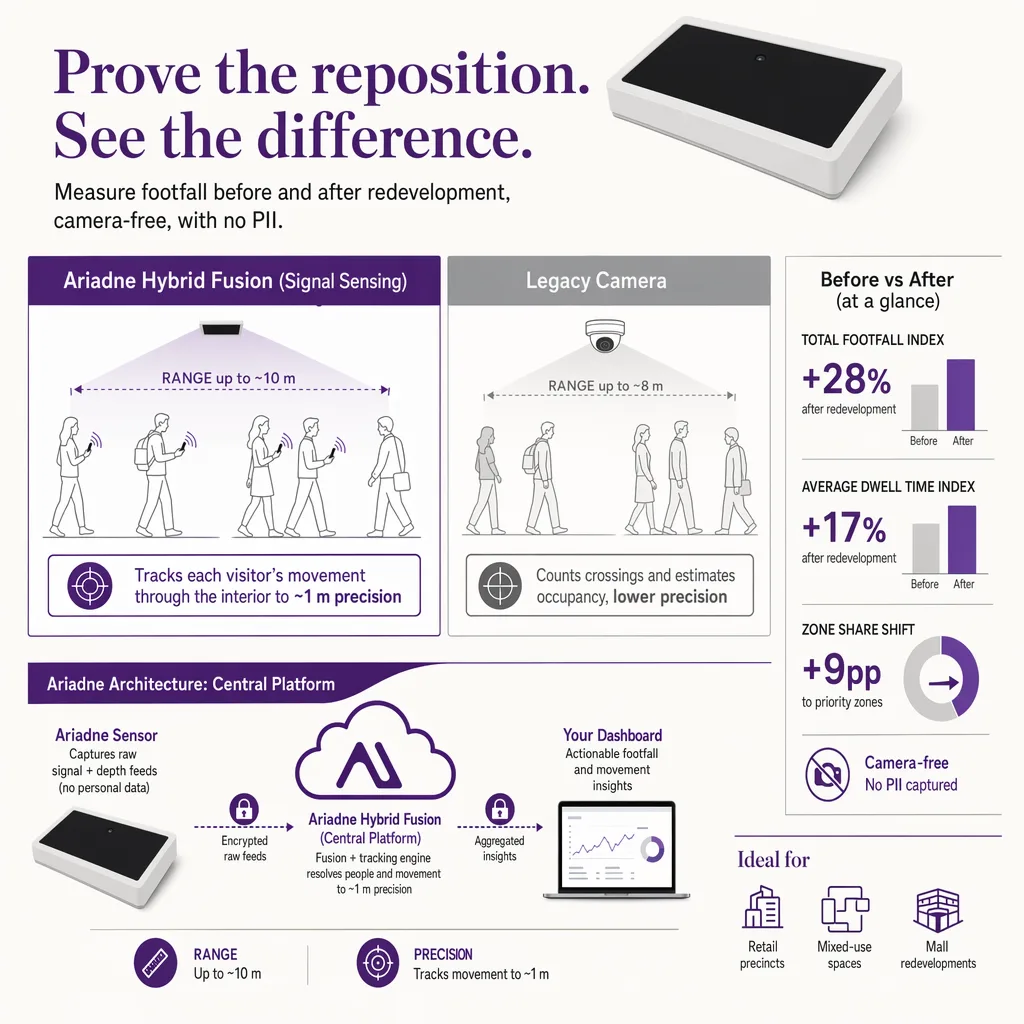
Ariadne measures this with Hybrid Fusion, its patented camera-free method. Time-of-Flight depth sensing counts every visitor at the entrances, capturing geometry rather than images, while patented phone signal sensing follows movement through the interior, detecting the signals a phone emits even in airplane mode. The sensor streams both feeds to Ariadne, where Hybrid Fusion combines them into one trajectory per visit and computes counts, dwell, and paths. The streams carry no identifier: no MAC address, no device ID, no biometric data, and no camera is involved. Identifiers are stored only when a visitor explicitly opts in, which keeps the method GDPR-friendly and outside biometric territory.
Two properties of that method matter for a redevelopment case specifically. First, because the entry count comes from fixed measurement points, the before and the after are read at the same doors in the same way, which is what makes a like-for-like comparison honest rather than a comparison of two different counting setups. Second, because the fusion produces dwell and interior paths as well as entries, an experiential or mixed-use play can be judged on the metric it was actually built to move, longer visits and movement between the new zones, not just a headline entry number. Running the count continuously through the works also captures the construction-period dip as real data instead of a guess, so the baseline correction rests on measurement.
The point is not that you need one particular vendor to do this. It is that the before-and-after has to be measured consistently, corrected for season and market, and read at the sustained level rather than the spike. Any people-counting method that gives you a stable, like-for-like count through the whole project, before, during, and long after, can carry the case; the discipline is what makes it defensible, and shopping center analytics is where that discipline lives across a portfolio.
FAQ
How long should you measure footfall after a mall reopening?
At least twelve months, and ideally alongside the pre-works baseline for the same seasons. The reopening spike fades within weeks, so the honest test of a redevelopment is sustained footfall at six and twelve months, not the launch quarter.
What is the biggest mistake in measuring redevelopment footfall?
Comparing the busy reopening period against the depressed construction period. That stacks the best week against the worst and reports the gap as a success, when much of it is simply the works ending and the curiosity crowd arriving.
How do you separate real new footfall from cannibalized visits?
By measuring at consistent points across the whole center, not just the redeveloped section, so you can see whether the new zone drew net-new visitors or simply pulled traffic from other parts of the property. Interior path data helps show where visits actually came from.
Do you need a control center to prove a redevelopment worked?
It is not strictly required, but it is the cleanest way to separate the project's effect from market-wide movement. A comparable center that was not redeveloped shows how much of your change came from the wider retail climate rather than the works.
Does a mixed-use conversion change how you measure footfall?
Yes. Residents and workers on a converted site are a frequent, captive base rather than discretionary shoppers, so their visits behave differently from retail draw. A credible measurement separates that new resident-and-worker traffic from genuine shopping footfall.
Why is footfall the right metric to hold a redevelopment to account?
Because it is the earliest clean signal in the chain the business case is built on. Tenant sales arrive late and are often self-reported, and valuation moves on a lag and on outside factors. Footfall shows within months of reopening whether the physical changes are pulling the people the case promised, while there is still time to adjust leasing or marketing.
Should you measure footfall during construction, not just before and after?
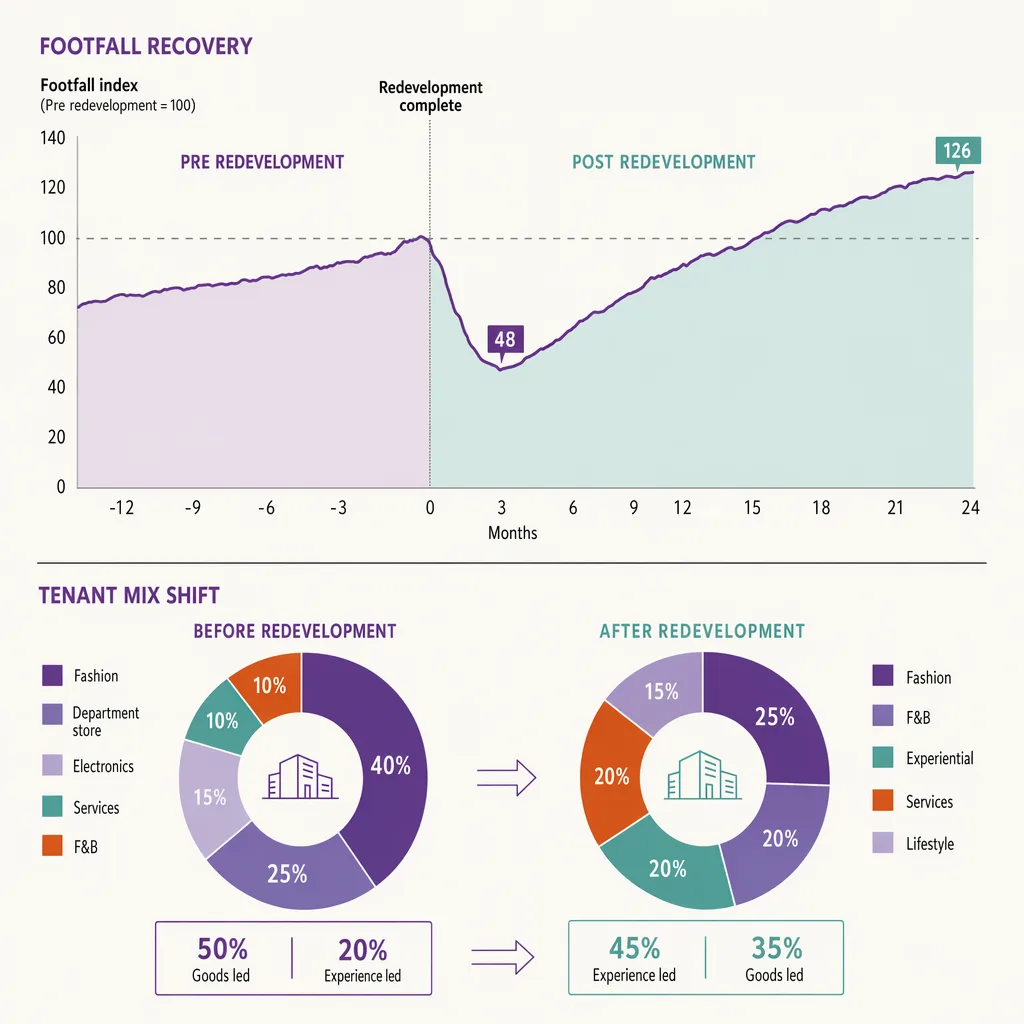
Yes. Counting continuously through the works captures the construction-period dip as real data rather than a guess. That matters because comparing the reopening against the depressed construction period is the most common way redevelopment success gets overstated, and only measured data lets you correct for it honestly.


