
The layer every journey claim stands on
Journey maps, funnel stages, KPI dashboards: all of it is only as real as the touchpoint measurement underneath. If "shoppers dwell at the denim wall" comes from an afternoon of observation, the map is a sketch. This post is about the measurement layer itself: what a touchpoint is technically, how it gets measured continuously without cameras, and where the honest limits sit.
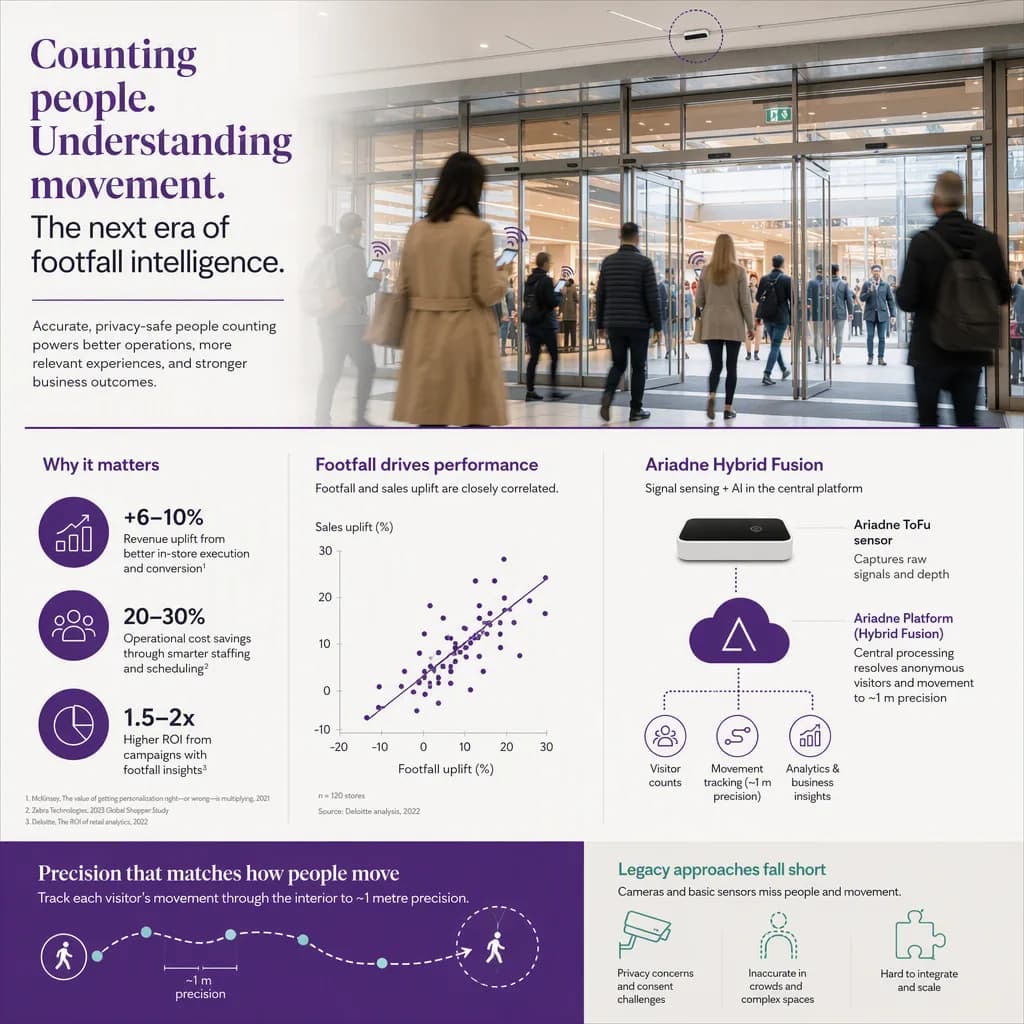
How are customer journey touchpoints measured in a store?
A physical touchpoint is a place-and-behavior pair: presence in a zone, dwell beyond a threshold, passage across a line, arrival at a service point. Measuring them continuously requires sensing that (a) covers entrances exactly, (b) follows movement between zones, and (c) never needs to know who anyone is. In Ariadne's case that is Hybrid Fusion, described below; the output is a stream of anonymous trajectories from which every touchpoint metric (reach, dwell, sequence, abandonment) is computed in the platform.
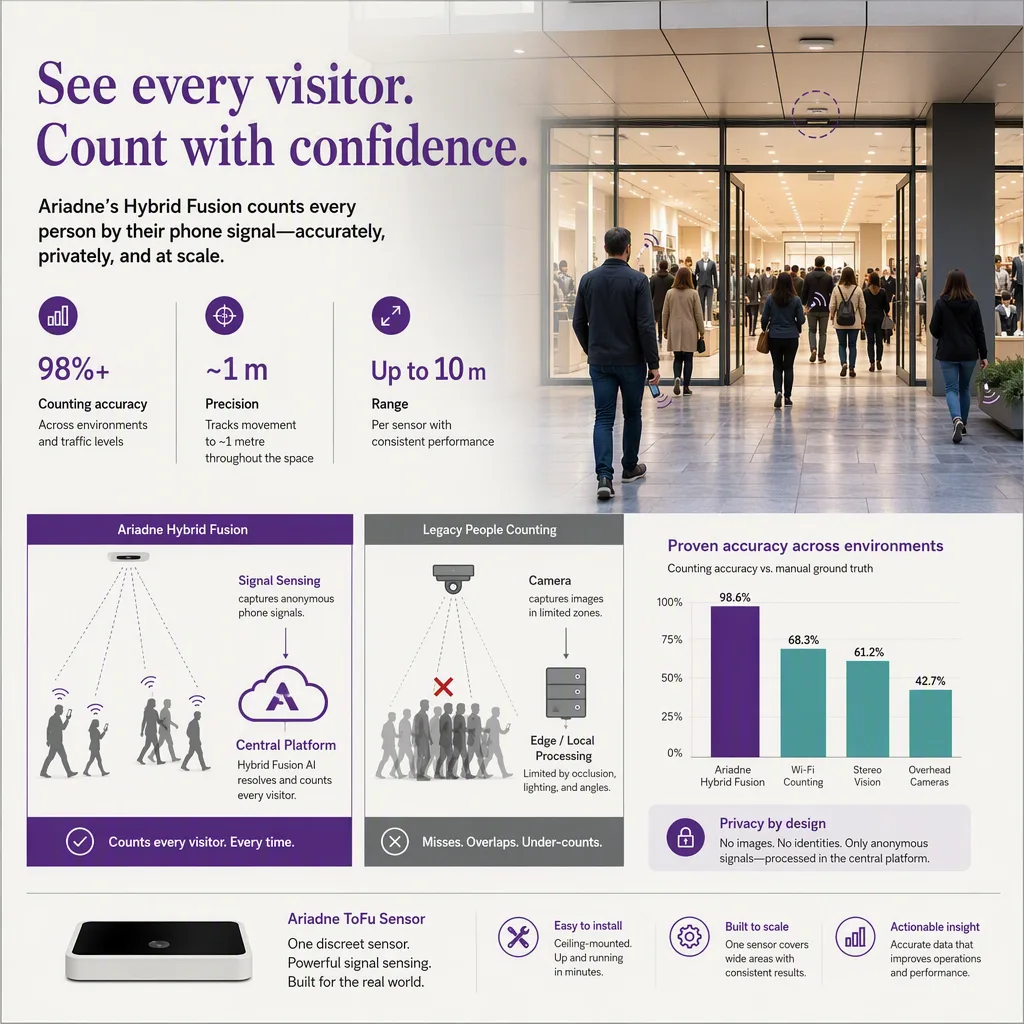
Ariadne measures this with Hybrid Fusion, its patented camera-free method. Time-of-Flight depth sensing counts every visitor at the entrances, capturing geometry rather than images, while patented phone signal sensing follows movement through the interior, detecting the signals a phone emits even in airplane mode, and tracks that movement to about one-metre precision. The sensor streams both feeds to Ariadne, where Hybrid Fusion combines them into one trajectory per visit and computes counts, dwell, and paths. The streams carry no identifier: no MAC address, no device ID, no biometric data, and no camera is involved. Identifiers are stored only when a visitor explicitly opts in, which keeps the method GDPR-friendly and outside biometric territory.
From trajectory to touchpoint
A trajectory is a path with timestamps. Touchpoints are declarative overlays on it: define the fitting-room approach as a zone, and every trajectory entering it becomes a try-on-funnel event; define the service desk, the demo table, the queue line, and the same trajectories light up different funnels. This is the practical power of measuring journeys rather than points: new touchpoints are configuration, not new hardware. A zone counter answers the question it was installed for; a trajectory answers questions you had not thought to ask yet.
What the layer sees, and what it deliberately cannot
It sees: how many, which way, how long, in what order, at what time. It cannot see: who, what demographic, what mood, what was picked up, or what was said, and it cannot be upgraded into seeing them, because the sensing captures geometry and signals rather than images. That boundary is a feature twice over: it keeps the measurement inside privacy-by-construction territory (the argument in counting vs surveillance), and it keeps the analysis honest, since journey claims stay behavioral instead of drifting into demographic guesswork.

Accuracy is a property of the layer, not the dashboard
Every downstream KPI inherits the counting layer's accuracy, so validation belongs at the layer: ground-truth the entrance counts with a written procedure (the accuracy test methodology), understand the known error sources (accuracy factors), and treat zone definitions as part of the measurement (a zone drawn across a walkway measures traffic, not interest). Cross-validation between the two sensing streams, exact door counts against interior journeys, is the structural advantage of fusion described in sensor fusion for people counting.
Where this layer leads
With touchpoints measured continuously, the journey work becomes analytical instead of anecdotal: funnels per vertical (fashion, grocery), a standard KPI stack (customer journey KPIs), and the mapping method itself, the pillar at customer journey mapping.
---


