
Irisys is one of the longer-standing names in people counting, with a large installed base and a sensing approach built on infrared and depth rather than conventional cameras. So if you are looking at an Irisys alternative, the comparison worth making is not "camera versus no camera," because Irisys does not put a camera at the door either. The comparison is about where the measurement happens, what data the platform holds afterward, and how each system stands up when you test it at your own entrances.
This post walks the four axes that decide a counting purchase, sets Irisys and Ariadne side by side on each, and then describes where Ariadne differs on its own terms: interior signal fusion, no identifier captured by default, and a clear EU AI Act posture. Comparisons cite public documentation; no client relationship or disparagement intended.
What is an Irisys alternative?
An Irisys alternative should be judged on accuracy verified at your own entrances, what the sensor records about visitors, how it installs, and five-year cost. Ariadne is a camera-free option using Hybrid Fusion, Time-of-Flight depth sensing at entries plus patented phone-signal sensing inside, fused in the platform, recording no MAC address by default and no biometric data. Irisys describes its counting products as using infrared and depth sensing, including its Vector 4D line; confirm the current sensing approach for the specific Irisys product you are weighing from its public documentation before drawing a side-by-side.
The two systems agree on a great deal: both count people without a conventional camera, and both aim for high door-count accuracy. Where they part company is what the platform does with movement inside the building and what it retains about each visitor, which is where a buyer-side comparison earns its keep.
How to compare counting vendors on the four axes that matter
Strip a counting decision back and it rests on four questions.
Accuracy on your own site comes first. A published accuracy figure is measured under conditions the vendor selected, so it is a starting point, not an answer. The number that transfers to your estate is the count error at your doors, with your traffic and your door geometry, measured against a manual ground-truth count. Treat this as a requirement for every vendor on the shortlist, and use a documented method to verify accuracy on your own site rather than trusting a datasheet.
What the sensor records about each visitor comes second, and it often decides more than accuracy does, because it sets the privacy-documentation burden. Infrared, depth, and signal-based methods sit very differently from image-based ones on this axis. For the underlying distinction, thermal vs ToF vs stereo sensors explains what each sensing family can and cannot see, which is the technical foundation for any capture comparison.
The install model comes third: ceiling height, mounting, cabling, power, and whether counting runs on the sensor or centrally in a platform. Fourth is five-year cost, the full picture of hardware, install labour, subscription, support, and any recalibration, not the headline price per door.
Irisys vs Ariadne, at a glance
The table compares the two at the level each vendor's public documentation supports. "Verify on your own site" marks the cells you should confirm directly, including against Irisys's own documentation. Ariadne's cells state its canonical posture only.
| Axis | Irisys | Ariadne |
|---|---|---|
| Sensing method | Infrared and depth sensing per Irisys public documentation, including the Vector 4D line | Camera-free Hybrid Fusion: Time-of-Flight depth at entries plus patented phone-signal sensing inside, fused centrally in the platform |
| What it records | Verify on your own site against Irisys documentation | No MAC address by default, no device ID, no biometric data, no images; identifiers stored only on explicit visitor opt-in |
| Camera involved | No (infrared / depth per Irisys) | No |
| Verified-on-site accuracy | Verify on your own site with a ground-truth count | Verify on your own site; do not rely on a datasheet number for either vendor |
| Five-year cost basis | Verify on your own site (hardware, install, subscription, support) | Verify on your own site (hardware, install, subscription, support) |
The "camera involved" row is the one to read carefully. Neither system uses a conventional camera at the door, so a "camera-free" headline does not separate them. The real difference is interior coverage and what data the platform keeps, which the next section sets out.
Where Ariadne differs on its own terms
The honest way to describe Ariadne is by its method rather than by anything asserted about Irisys.
Ariadne measures this with Hybrid Fusion, its patented camera-free method. Time-of-Flight depth sensing counts every visitor at the entrances, capturing geometry rather than images, while patented phone signal sensing follows movement through the interior, detecting the signals a phone emits even in airplane mode, and tracks that movement to about one-metre precision. The sensor streams both feeds to Ariadne, where Hybrid Fusion combines them into one trajectory per visit and computes counts, dwell, and paths. The streams carry no identifier: no MAC address, no device ID, no biometric data, and no camera is involved. Identifiers are stored only when a visitor explicitly opts in, which keeps the method GDPR-friendly and outside biometric territory.
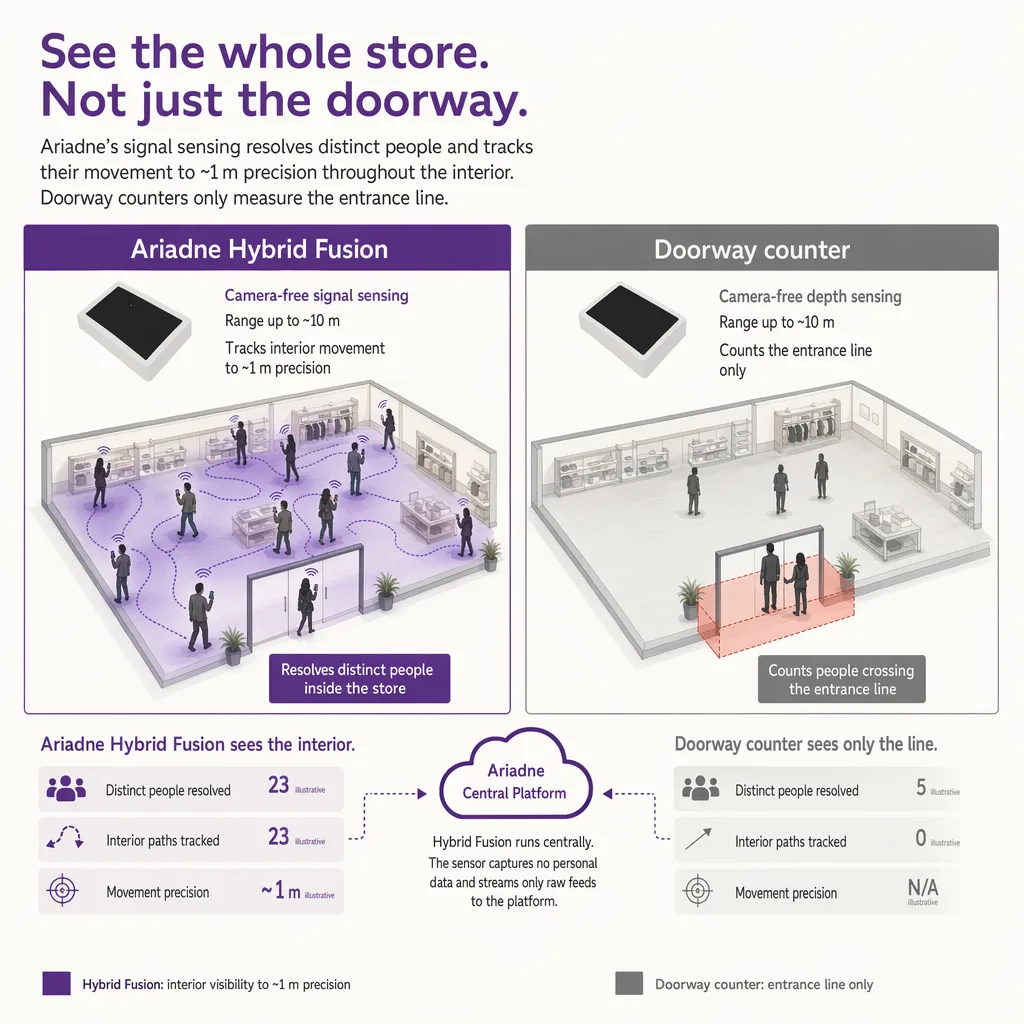
Two consequences of that method are worth drawing out. The first is interior coverage. Door-based sensing, whether infrared, depth, or signal, is strong at counting entries and exits. Ariadne adds a phone-signal layer through the interior, so the platform produces a visit path rather than a doorway tally. For a retailer or center operator asking where visitors go after they enter, and which zones they dwell in, that shift in what gets measured is often the deciding factor, above a fractional difference in entry-count accuracy.
The second is what the platform holds by default. The streams carry no identifier and no biometric data, and identifiers are stored only when a visitor explicitly opts in. Because no biometric identification or categorisation takes place, the measurement sits outside the EU AI Act's biometric categories rather than needing to be argued into an exemption. None of this is a claim about Irisys, whose infrared and depth methods are also not image-based per its public materials. It is a statement of what Ariadne captures, which is the only fair basis for a comparison.
What to verify before signing
Two systems that both count without a camera can still be very different buys, so the last step is verification rather than another feature grid.
Verify capture first. Ask each vendor, in writing, exactly what its product records and retains: raw sensor data, derived counts, any identifier, and how long each is kept. For Irisys, confirm this against its current product documentation for the specific model you are considering, since a product line can span several sensing generations. For Ariadne, the answer is the canonical posture above, and it should be confirmed in the contract like any other.
Verify accuracy second, with a pilot. One representative entrance, both systems, a manual count over the same period, and a comparison of each system's report to your ground-truth figure. A pilot also exposes the install realities and the interior-coverage difference in a way a datasheet cannot; running a trial first is the cheapest insurance against buying the wrong system for your estate.
Verify cost third, across five years, not on the sticker. When you have those three answers from your own site, the named-market picture in the systems comparison and the deployment detail on Ariadne's camera-free counting become useful context rather than a substitute for evidence. For a structured way to work through the decision end to end, see how to choose a people counter.
FAQ
Is Irisys a camera-based people counter?
No. Irisys's public documentation describes infrared and depth sensing for its counting products, including its Vector 4D line, rather than conventional cameras. Confirm the exact sensing method for the specific Irisys product you are evaluating from its current documentation, because the brand's counting line has spanned more than one sensing generation, and verify what it records against your own privacy requirements.
Do I need cameras to count people accurately?
No. Ariadne counts with Hybrid Fusion: Time-of-Flight depth sensing plus patented phone signal sensing, never cameras. Time-of-Flight captures geometry rather than images, and signal sensing captures no MAC address by default, so the measurement involves no video, no faces, and no biometric data.
What is the real difference between Irisys and Ariadne?
Both count without a conventional camera, so a camera-free comparison does not separate them. The difference is where the measurement happens and what the platform retains. Ariadne fuses door counts with interior phone-signal sensing to produce a visit path, not only an entry count, and it holds no identifier or biometric data by default. Compare the two on interior coverage and on what each records, not on a camera-versus-camera-free line.
How do I compare accuracy between the two fairly?
Run a like-for-like pilot. Install each system on the same representative entrance, count manually over the same period, and compare each system's report to your ground-truth count. Advertised accuracy figures from either vendor are measured under conditions the vendor chose, so they do not transfer directly to your estate. A documented on-site test is the number that does.
Does Ariadne track people through the whole building or just the door?
Ariadne's Time-of-Flight layer counts at the entrances, and its patented phone-signal layer follows movement through the interior, so the platform reports visit paths and dwell inside the space, not only an entry and exit count. This interior coverage is the practical difference from a purely door-based counter, and it does so while holding no identifier or biometric data by default.


