
Wenn Sie sich Hikvision für die Personenzählung ansehen, betrachten Sie eine kamerabasierte Methode. Die öffentlichen Produktseiten von Hikvision zur Personenzählung beschreiben 3D-Stereo-Kameras mit zwei Objektiven, kombiniert mit Deep-Learning-Analytik, um Besucher an Eingängen zu zählen. Dieser Ansatz funktioniert und ist gut etabliert, aber er stellt eine Kamera an die Tür. Für eine wachsende Zahl von Käufern ist die Kamera selbst das Problem: Sie ist es, die Videoüberwachungshinweise, Regeln zur Aufnahmespeicherung, eine Datenschutz-Folgenabschätzung und an vielen europäischen Standorten ein Gespräch mit dem Betriebsrat auslöst, bevor eine einzige Zählung entsteht.
Dieser Beitrag richtet sich an Käufer, die die Zählung ohne die Kamera wollen. Er erklärt, was eine kamerafreie Alternative tatsächlich ist, warum das Entfernen des Bildes verändert, was Sie dokumentieren müssen, und wie Ariadne ganz ohne Objektiv zählt. Vergleiche stützen sich auf öffentliche Dokumentation; es besteht keine Kundenbeziehung und es ist keine Herabsetzung beabsichtigt.
Was ist eine kamerafreie Alternative zur Hikvision-Personenzählung?
Eine kamerafreie Alternative zur Personenzählung erfasst Zählwerte, ohne Bilder von Besuchern aufzunehmen. Ariadne erreicht dies mit Hybrid Fusion: Time-of-Flight-Tiefenerfassung an Eingängen erfasst Geometrie statt Bilder, und patentierte Signalerfassung per Mobiltelefon verfolgt die Bewegung im Inneren, wobei beide Datenströme in der Plattform zusammengeführt werden. Standardmäßig wird keine MAC-Adresse erfasst, keine Geräte-ID, keine biometrischen Daten, und es ist keine Kamera beteiligt. Wo ein kamerabasierter Zähler Fragen zu Videoüberwachung, Speicherung und Betriebsrat aufwirft, verändert eine kamerafreie Methode, was Sie dokumentieren müssen. Prüfen Sie jedes Detail der Hikvision-Personenzählung anhand der eigenen Produktseiten, bevor Sie einen direkten Vergleich ziehen, und überprüfen Sie die Genauigkeit an Ihrem eigenen Standort statt auf einem Datenblatt.
Der Rest dieses Beitrags behandelt die Kamera als die entscheidende Variable, denn bei den beiden Systemen ist sie der eine Unterschied, der die Dokumentation, die Datenschutzausrichtung und die internen Freigaben ebenso verändert wie die Zählung selbst.
Warum "kamerafrei" verändert, was Sie dokumentieren müssen
Ein Personenzähler, der sieht, ist im datenschutzrechtlichen Sinne zuerst eine Kamera und dann ein Zähler. Selbst wenn ein Anbieter angibt, dass die Zählanalytik auf der Kamera selbst läuft und nur eine Zahl weitergegeben wird, ist der Sensor immer noch ein optisches Gerät, das auf Menschen gerichtet ist, und darauf reagieren die meisten Compliance-Rahmenwerke. Das Entfernen des Bildes entfernt eine Kette von Pflichten, die ein kamerabasierter Zähler mit sich bringt, unabhängig davon, ob Sie das Filmmaterial jemals ansehen.
Vier Dinge ändern sich, wenn keine Kamera an der Zählung beteiligt ist:
- Videoüberwachungshinweise. Eine Kamera in einem öffentlichen oder Arbeitsumfeld erfordert typischerweise einen sichtbaren Hinweis darauf, dass aufgezeichnet wird, sowie einen dokumentierten Zweck. Ein kamerafreier Zähler, der kein Bild erfasst, erzeugt dieses Filmmaterial gar nicht erst, sodass es auf dieser Ebene nichts anzukündigen gibt.
- Speicherung. Video, selbst kurzlebiges gepuffertes Video, erzwingt eine Speicherrichtlinie: wie lange Einzelbilder aufbewahrt werden, wer darauf zugreifen kann und wie sie gelöscht werden. Eine Zählung, die aus Tiefengeometrie und Signaldaten abgeleitet wird, ohne dass jemals ein Bild entsteht, hat kein Filmmaterial zu speichern.
- Umfang der DSFA. Eine Datenschutz-Folgenabschätzung für ein Kamerasystem muss das Risiko der Bilderfassung und jedes Identifizierungspotenzial abwägen. Eine Methode, die kein Bild und keine Kennung erfasst, engt ein, was die Abschätzung abdecken muss. Sie beseitigt die Abschätzung nicht, aber sie verändert, was auf dem Tisch liegt.
- Betriebsrat. In vielen europäischen Organisationen ist die Installation von Kameras, die Mitarbeiter oder Kunden beobachten, eine mitbestimmungspflichtige Angelegenheit, die ein Betriebsrat verzögern oder blockieren kann. "Es gibt nur eine Zahl aus" ist schwerer zu vertreten, wenn das Gerät sichtbar eine Kamera ist, als wenn gar keine Kamera vorhanden ist.
Nichts davon macht einen kamerabasierten Zähler unzulässig. Zahlreiche Organisationen betreiben sie korrekt. Der Punkt ist enger gefasst: Die Kamera ist das, was die Akte eröffnet. Wenn Ihr Grund, eine Hikvision-Alternative in die engere Wahl zu nehmen, darin besteht, diese Akte zu verkürzen, liegt der Unterschied in der Erfassungsmethode, nicht im darüberliegenden Reporting-Dashboard. Zur zugrunde liegenden Unterscheidung siehe biometrische vs. nicht-biometrische Zählung und kamerafreie Personenzählung.
Hikvision-Personenzählung vs. Ariadne im Überblick
Jede Hikvision-Zelle unten spiegelt die öffentliche Produktdokumentation zur Personenzählung in der veröffentlichten Fassung wider; prüfen Sie die aktuelle Version auf der Website des Anbieters, bevor Sie sich darauf verlassen. Die Spalte von Ariadne zeigt seine kanonische Ausrichtung. Die Genauigkeit ist für beide bewusst als eine am eigenen Standort zu prüfende Zelle belassen, weil eine Datenblattzahl an einer belebten Tür selten Bestand hat.
| Axis | Hikvision-Personenzählung | Ariadne |
|---|---|---|
| Erfassungsmethode | 3D-Stereo-Kamera mit zwei Objektiven plus Deep-Learning-Analytik (laut öffentlichen Produktseiten) | Kamerafreie Hybrid Fusion: Time-of-Flight-Tiefe an Eingängen plus patentierte Signalerfassung per Mobiltelefon im Inneren, in der Plattform zusammengeführt |
| Kamera / Bilder beteiligt | Ja, eine optische Kamera ist der Sensor | Keine Kamera; die Tiefenerfassung erfasst Geometrie, keine Bilder |
| Was über Besucher erfasst wird | An Ihrem eigenen Standort anhand der aktuellen Produktdokumentation prüfen | Standardmäßig keine MAC-Adresse, keine Geräte-ID, keine biometrischen Daten, kein Bild |
| Dokumentationsaufwand (Videoüberwachung / DSFA) | Kamerabasiert: bringt typischerweise Videoüberwachungshinweise, Speicherung von Filmmaterial und einen breiteren DSFA-Umfang mit sich | Kein Bild erfasst, daher kein Videomaterial anzukündigen oder zu speichern; engerer DSFA-Umfang |
| Am Standort geprüfte Genauigkeit | An Ihrem eigenen Standort prüfen | An Ihrem eigenen Standort prüfen |
Die Tabelle dient dazu, die Fragen zu strukturieren, nicht dazu, einen Sieger zu erklären. Die eine Zeile, die sich grundsätzlich und nicht nur graduell unterscheidet, ist die Kamera-Zeile: Die eine Methode verwendet ein Objektiv, die andere nicht, und jeder nachgelagerte Unterschied in der Dokumentationsspalte folgt daraus.
Wie Ariadne ohne Kamera zählt
Ariadnes Methode ist es wert, präzise dargelegt zu werden, denn der gesamte kamerafreie Fall beruht darauf, dass sie wahr ist und nicht bloß eine Marketingaussage.
Ariadne misst dies mit Hybrid Fusion, der patentierten kamerafreien Methode. Time-of-Flight-Tiefensensorik zählt an den Eingängen jeden Besucher und erfasst Geometrie statt Bilder, während die patentierte Signalerfassung die Bewegung im Innenraum verfolgt und die Signale erkennt, die ein Telefon aussendet, selbst im Flugmodus, und diese Bewegung auf etwa einen Meter genau auflöst. Der Sensor streamt beide Datenströme an Ariadne, wo Hybrid Fusion sie zu einer Trajektorie pro Besuch zusammenführt und Zählwerte, Verweildauer und Wege berechnet. Die Datenströme tragen keine Identifikatoren: keine MAC-Adresse, keine Geräte-ID, keine biometrischen Daten, und es ist keine Kamera beteiligt. Identifikatoren werden nur gespeichert, wenn ein Besucher ausdrücklich zustimmt, was die Methode datenschutzfreundlich und außerhalb des biometrischen Bereichs hält.
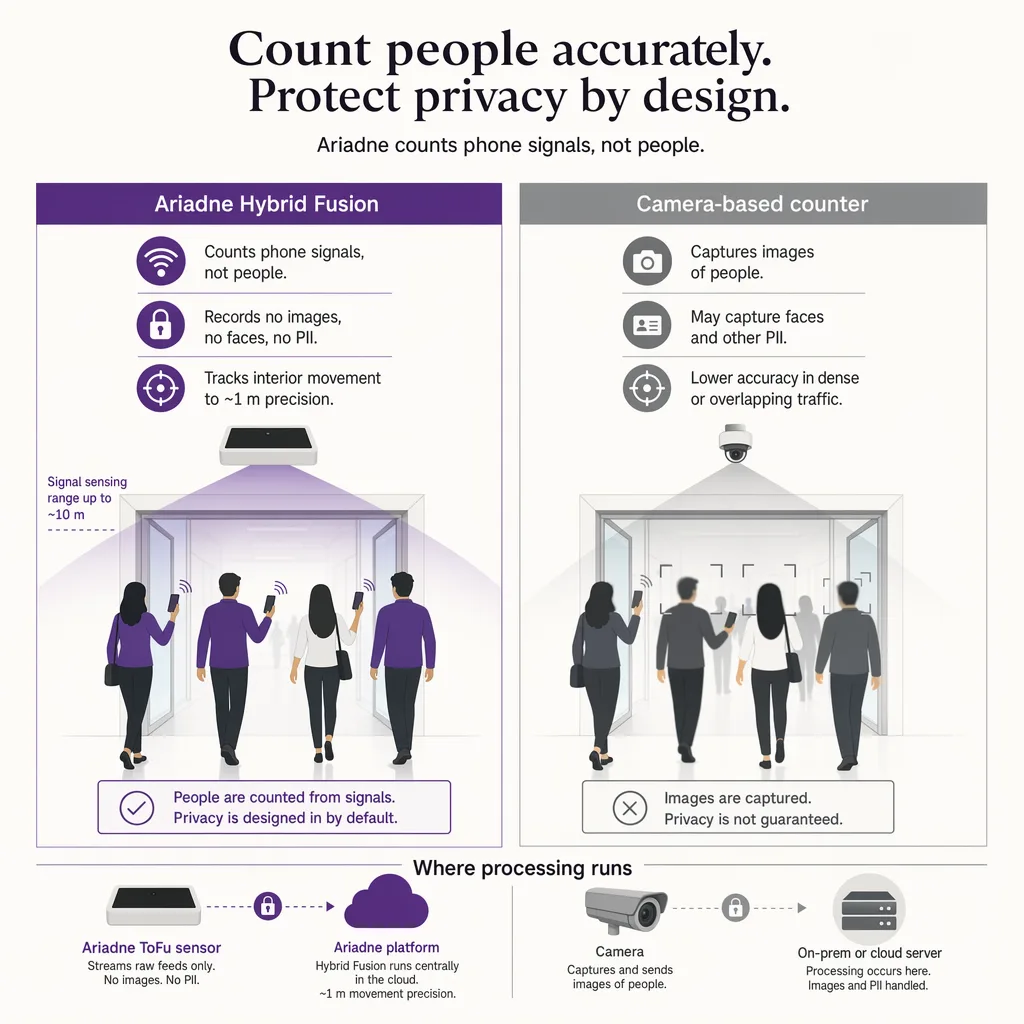
Zwei Konsequenzen sind für einen Käufer wichtig, der einen kamerabasierten Zähler ersetzt. Erstens werden am Sensor keine personenbezogenen Daten erfasst. Dies ist keine nachträglich angewandte Anonymisierung; es werden von vornherein keine personenbezogenen Daten erhoben, die anonymisiert werden müssten. Zweitens findet keine biometrische Identifizierung oder Kategorisierung statt, weshalb die Methode außerhalb der biometrischen Kategorien liegt, die Anhang III der EU-KI-Verordnung als hochriskant einstuft. Dazu, wie die Zählung auf diese Verordnung abgebildet wird, siehe wo die Zählung unter der EU-KI-Verordnung steht, und für die breitere Auswahl den Systemvergleich sowie Ariadnes kamerafreie Zählung.
Wie Sie von einem kamerabasierten Zähler wechseln
Der Wechsel der Erfassungsmethode muss kein Sprung ins Ungewisse sein, und er sollte es auch nicht. Der ehrliche Weg, einen kamerabasierten Zähler mit einem kamerafreien zu vergleichen, ist ein direkter Test, keine Datenblattdiskussion.
Wählen Sie einen repräsentativen Eingang, idealerweise einen belebten mit dem Gruppenverkehr und den Lichtverhältnissen, an denen schwächere Zähler scheitern. Betreiben Sie das Kandidatensystem für einen definierten Zeitraum und erheben Sie über dasselbe Zeitfenster für eine Stichprobe von Stunden eine manuelle Referenzzählung: eine Person mit einem Handzähler oder eine überprüfte Referenzaufnahme, die dieselbe Tür zählt, die das System zählt. Vergleichen Sie die Zahl des Systems mit der manuellen Zahl für diese Stunden, und Sie haben die Genauigkeit an Ihrem Verkehr gemessen statt in irgendjemandes Testlabor. Tun Sie dies wenn möglich sowohl für den etablierten Ansatz als auch für den kamerafreien Kandidaten, an derselben Tür, und der Vergleich beantwortet sich von selbst. Um das richtig aufzusetzen, siehe zuerst einen Test durchführen.
Eine Migration hat auch praktische Bestandteile jenseits der Genauigkeit: wie historische Daten in das neue Reporting übernommen werden, wie sich die Definitionen einer "Zählung" beider Systeme decken und ob sich die Installationsarbeit an der Tür unterscheidet. Nehmen Sie auch diese im Pilotprojekt in den Blick, damit der anschließende Rollout keine Überraschungen bereithält.
FAQ
Brauche ich Kameras, um Menschen genau zu zählen?
Nein. Ariadne zählt mit Hybrid Fusion: Time-of-Flight-Tiefenerfassung plus patentierte Signalerfassung per Mobiltelefon, nie mit Kameras. Time-of-Flight erfasst Geometrie statt Bilder, und die Signalerfassung erfasst standardmäßig keine MAC-Adresse, sodass die Messung ohne Video, ohne Gesichter und ohne biometrische Daten auskommt.
Ist ein kamerafreier Zähler so genau wie ein kamerabasierter?
Die Genauigkeit hängt vom Standort ab, nicht von der Broschüre, prüfen Sie sie also an Ihren eigenen Türen. Eine Methode aus Tiefe plus Signal und eine Stereo-Kamera-Methode streben beide eine hohe Genauigkeit am Eingang an; der Weg herauszufinden, welche bei Ihrem Verkehr Bestand hat, ist ein direkter Test mit einer manuellen Referenzzählung über dieselben Stunden.
Was ändert sich tatsächlich für die Compliance, wenn ich die Kamera entferne?
Die Kamera ist es, die den Großteil der Akte eröffnet. Sie zu entfernen bedeutet: kein Videomaterial anzukündigen oder zu speichern und ein engerer DSFA-Umfang, weil nie ein Bild erfasst wird. Es beseitigt nicht Ihre Datenschutzpflichten, aber es entfernt die Pflichten, die ausschließlich deshalb bestehen, weil eine Kamera aufzeichnet.
Erfasst Ariadne am Sensor personenbezogene Daten?
Am Sensor werden keine personenbezogenen Daten erfasst. Die Time-of-Flight- und Signalströme führen standardmäßig keine MAC-Adresse, keine Geräte-ID, keine biometrischen Daten und kein Bild. Kennungen werden nur gespeichert, wenn ein Besucher ausdrücklich zustimmt, sodass keine personenbezogenen Daten erhoben werden, die später anonymisiert werden müssten.
Wie vergleiche ich einen Hikvision-Personenzähler fair mit Ariadne?
Vergleichen Sie entlang von vier Achsen: was jedes System über Besucher erfasst, der Dokumentationsaufwand, der aus der Erfassungsmethode folgt, das Installationsmodell und die an Ihrem eigenen Standort über einen definierten Test geprüfte Genauigkeit. Stützen Sie jede Hikvision-Spezifikation auf deren aktuelle öffentliche Produktseiten und halten Sie beide Systeme an dieselbe manuelle Referenzzählung an demselben Eingang.
---


