
A furniture showroom does not get the traffic a fashion store sees, and that is exactly why every visitor counts more. Sofas, beds, and dining sets are bought a few times in a decade, so a showroom can pass a whole morning with a handful of people on the floor and still close enough orders to make the day. The trouble is telling the difference between the two. When the till is quiet, was it a slow traffic day, or did people walk the floor and leave without buying? Without a count at the door, that question gets answered by feel, and feel is wrong often enough to staff and lay out the floor against the wrong story.
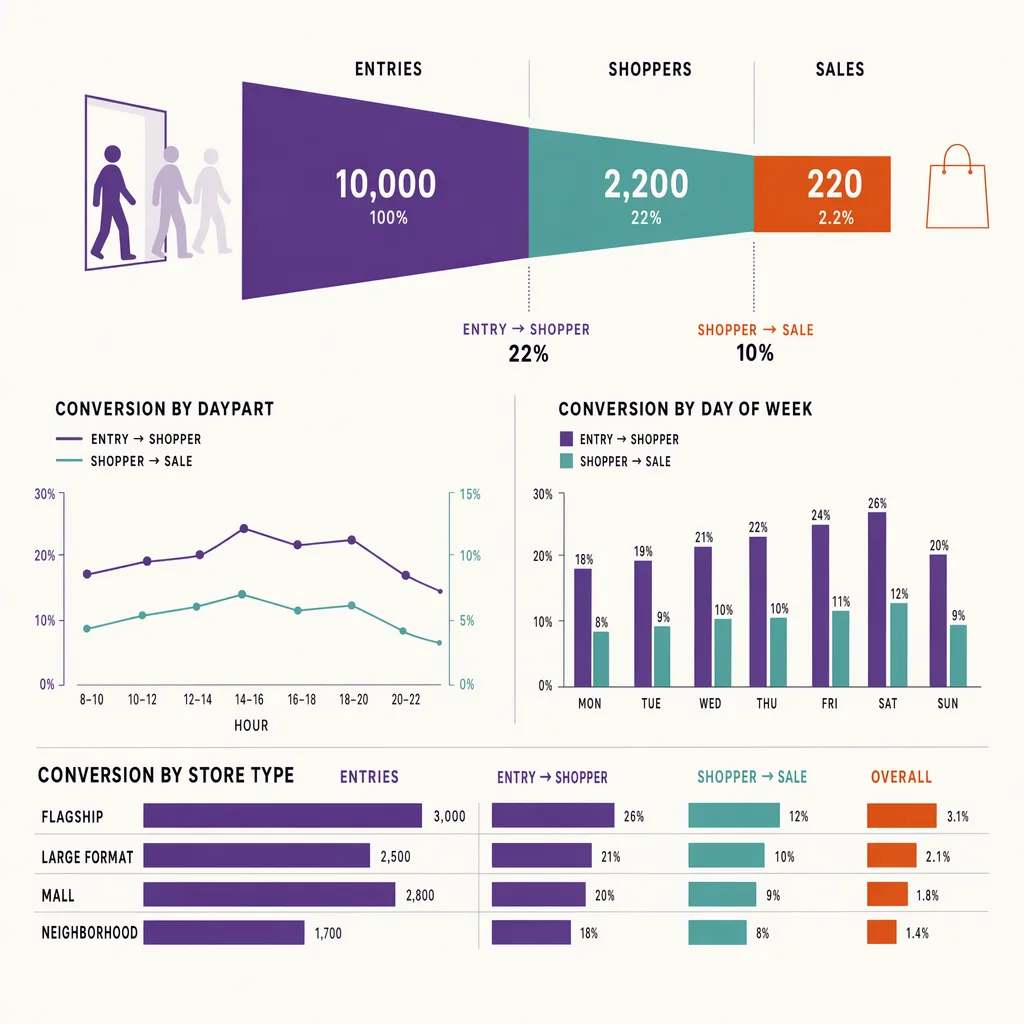
This is a guide to what footfall counting actually changes for a big-format furniture showroom. It covers the conversion number that matters in big-ticket retail, how to read traffic across a large floor zone by zone, how counting holds up accuracy in a wide open showroom with broad doors and long sightlines, and how a showroom manager turns the numbers into Monday-morning decisions about layout, cover, and follow-up.
What does footfall counting do for a furniture showroom?
Furniture is a low-frequency, high-value purchase, so a showroom sees few visitors but each one matters. Footfall counting tells you how many people actually walked the floor against how many orders closed, which is the conversion number that decides whether a quiet day was low traffic or weak selling. On a large showroom it also shows which displays and zones pull people in and where the floor goes dead, so layout and staffing follow the route customers actually take.
The point is not the headline visitor number. It is the relationship between that number and everything else you already measure: orders written, average order value, sales staff on the floor. A count at the door turns a one-line takings figure into a story you can act on.
Furniture also carries a wrinkle most retail formats do not: a single sale often spans more than one visit. A customer measures the room at home, comes back with a partner, then returns to sign. The takings land on the day of the deposit, but the buying decision was made across trips the till treats as unrelated. A door count will not stitch those visits into one customer on its own, but it gives you the honest total of trips made against orders closed, which is the first time most showrooms can see how much of their selling is really a multi-visit process rather than a one-shot close.
The showroom pain point: few visitors, high stakes, no idea whether a slow day was traffic or selling
A grocery store can absorb a bad hour because the next hour brings hundreds more people. A furniture showroom cannot. A weekend where twelve groups came in instead of the usual thirty is a serious shortfall, but nobody on the floor reliably notices the difference between twelve and thirty across a day spread over a few thousand square metres. The brain rounds a slow showroom up to "a bit quiet" and a busy one down, and neither matches the books.
That blind spot has a cost. If the real problem on a soft Saturday was traffic, the fix is marketing: the local advertising, the window, the route from the car park. If the problem was conversion, the fix is the floor: the greet, the layout, the sales cover, the financing offer. Those are completely different responses, and you cannot choose between them on takings alone. You need to know how many people came in. A door count gives you the denominator that the conversion rate, and every decision that follows, depends on.
The cost is sharper in furniture than in fast retail because the unit of loss is so large. A clothing shop that misreads a Saturday loses a run of small baskets it can recover the next day. A furniture showroom that staffs a busy weekend too thin loses sofa orders worth four figures each, and there is no equivalent rush the following Tuesday to make them back. One unattended serious buyer is not a rounding error; it can be the difference between hitting the month and missing it. The stakes are the reason a showroom, of all formats, cannot afford to run on a feel for how busy it was.
Walk-in to order: the conversion number that matters in big-ticket retail
Conversion in fast-moving retail is a basket at the till against people through the door. In a furniture showroom the buying event is slower and bigger: a written order, often after one or more visits, sometimes a deposit today and delivery in weeks. So the conversion you track is walk-in groups against orders placed, and it sits at a very different level from a supermarket. A showroom that converts a meaningful share of its serious walk-ins is doing well, and the only way to know your real rate is to count the walk-ins, not guess at them.
Counting groups rather than heads matters here more than almost anywhere. Furniture is shopped by couples and families: two or three people arrive together to decide on one sofa, and they are one buying decision, not three. A counter that splits a couple into two visitors quietly halves your apparent conversion and makes a healthy floor look broken. Reading showroom walk-in metrics from the car-dealership world shows the same low-frequency, high-value pattern, where group-accurate counting is the foundation the whole number rests on. For the mechanics of turning entries into a rate, the conversion rate formula is the starting point, and sales per visitor is the metric that respects how much one furniture order is worth.
There is a second number worth tracking alongside the rate, and it is the one big-ticket retail tends to ignore: average order value against traffic. A showroom can lift takings two ways, by converting more of the people who come in or by selling more to each order, and the door count lets you tell which is happening. If conversion is flat but takings rose, the floor is upselling well, perhaps moving customers from a single sofa to a suite. If conversion rose but average order value slipped, you may be closing more deals on discounted clearance and training the floor to discount rather than to sell. Neither story is visible from takings alone, and both change what you ask of the sales team. Sales per visitor, read across the week, is the metric that holds both halves together: it rewards a floor that converts the right buyers to the right order, not just a floor that is busy.
Zone traffic across a large floor: which displays draw, which corners die
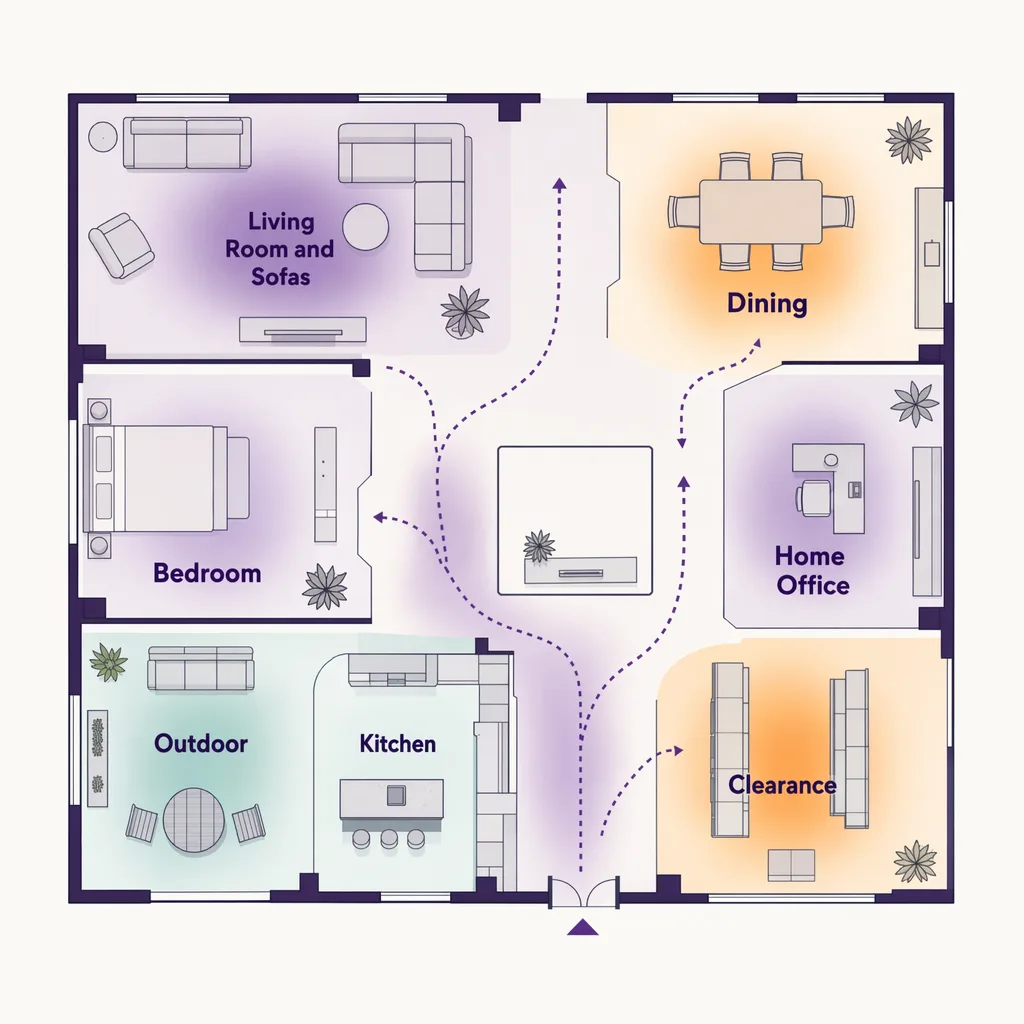
A furniture showroom is not one space, it is a set of room sets, departments, and routes laid out across a big floor. Bedrooms in one wing, dining in another, a clearance corner at the back, the big-ticket sofa displays near the entrance. Some of that floor works hard and some of it is dead, and the layout that looks balanced on a plan rarely matches where people actually walk.
Zone-level traffic data shows you the real picture: which displays stop people and pull them in, which routes carry the flow from the door, and which corners almost nobody reaches. That is the input for the decisions a showroom manager actually makes. If the high-margin sofa zone sits on a route few people take, it is in the wrong place regardless of how good the display is. If a back corner is dead, it is a candidate for clearance stock or a feature that earns a detour. Reading a floor heatmap is the same discipline applied to a showroom: the warm zones are where attention lands, the cold ones are the space you are paying rent on and not using.
Dwell makes the zone picture sharper than raw traffic does. In furniture, the zones that hold people longest are the ones doing the real selling, because a customer who sits on a sofa for four minutes is much closer to an order than one who walks past it. A zone can register high traffic and low dwell, which means it is on the main route but nothing in it stops anyone, and that is a merchandising problem rather than a placement one. A zone with modest traffic but long dwell is the opposite: a display that earns its keep with the few who reach it, which is an argument for moving it onto a busier path rather than changing what is in it. Reading traffic and dwell together is how a manager tells a poorly placed good display from a well-placed weak one, and they call for opposite fixes.
A practical way managers use this is the room-set audit. Most showrooms refresh their display room sets on a cycle, and the honest question is whether the new layout pulled people deeper into the floor or just rearranged the same dead corners. Comparing the zone picture for the weeks before and after a reset turns that from a matter of taste into a matter of evidence: if the new bedroom display lifted dwell and drew traffic past the dining range that used to be skipped, the reset worked, and you know which part of it carried the load.
Counting accuracy in a big open showroom
A furniture showroom is one of the harder counting environments in retail, and a cheap counter struggles with all of it at once. The entrances are wide, often automatic glass doors built for people carrying or wheeling things out. Visitors arrive in groups and drift rather than file through. The interior is huge, open, and full of large objects that a naive sensor can read as people. A single break-the-beam counter at one door, on a site like this, will undercount groups, miss side entrances, and tell you nothing about the floor beyond the threshold.
Ariadne measures this with Hybrid Fusion, its patented camera-free method. Time-of-Flight depth sensing counts every visitor at the entrances, capturing geometry rather than images, while patented phone signal sensing follows movement through the interior, detecting the signals a phone emits even in airplane mode, and tracks that movement to about one-metre precision. The sensor streams both feeds to Ariadne, where Hybrid Fusion combines them into one trajectory per visit and computes counts, dwell, and paths. The streams carry no identifier: no MAC address, no device ID, no biometric data, and no camera is involved. Identifiers are stored only when a visitor explicitly opts in, which keeps the method GDPR-friendly and outside biometric territory.

For a showroom that translates directly: depth at the door separates the couple from the family even on a wide glass entrance, and the interior signal sensing follows movement across the whole floor, which is what makes the zone-level picture possible rather than just a door tally. If a camera over the doors feels wrong in a showroom where customers are testing beds and trying out chairs, camera-free counting reaches the accuracy without putting a lens on the floor.
There is also the problem of the staff and the deliveries. A furniture showroom has salespeople crossing the floor all day, cleaners, and a steady traffic of stock and delivery movements through goods doors that a naive counter folds straight into the visitor total. On a low-traffic format that contamination matters more than it would in a busy shop, because a handful of stray staff counts can swing a small daily number by a noticeable percentage and make conversion look worse than it is. Following a trajectory across the floor rather than just breaking a beam at the threshold is part of what lets the count tell a customer who walks the room sets from a salesperson who crosses the same space twenty times a shift.
From counts to action: layout, sales-floor cover, appointment follow-up
The data earns its keep when it changes what the floor does on a Tuesday.
Layout is the first lever. The zone traffic tells you which displays are pulling and which routes are carrying flow, so you can move the high-margin ranges onto the busy path and treat a dead corner as a problem to solve rather than a fact to accept.
Sales cover is the second. Furniture selling is a long conversation, and a customer who waits while every salesperson is busy walks out and orders nowhere. Knowing the real shape of traffic across the week, including the weekend peaks and the dead weekday afternoons, lets you put the right number of people on the floor when the serious buyers are actually in. Staffing to the curve rather than a flat rota is the same logic retailers use elsewhere, with the stakes raised because one lost furniture conversation is a four-figure order, not a missed sandwich. The showroom version of this has a particular shape: the danger window is not the busiest hour but the hour when traffic is high and the floor is thin, often the late-Saturday surge when an early shift is winding down. Plotting cover against the traffic curve rather than the clock surfaces that gap directly, and a single extra person on the floor for two hours pays for itself in one saved order.
Follow-up is the third. Many furniture sales close on a second visit, so the gap between walk-ins and orders is partly a follow-up problem, not only a floor one. Knowing how many serious walk-ins you genuinely had, against how many came back and bought, tells you whether the leak is in the first conversation or in the chase afterwards. If the floor is getting good first conversations but few come back to sign, the problem is the follow-up discipline, the quote that never lands, the call that never happens. If they come back but do not buy, the problem is in the close. The door count cannot make those calls for you, but it tells you which of the two is leaking, which is the question a showroom usually argues about without any evidence at all.
How a showroom manager actually uses the numbers
In practice the data settles into a short weekly rhythm rather than a dashboard anyone stares at all day. The Monday review is the conversion read: how many groups came in across the week, how many orders closed, and whether the gap moved. A drop in traffic with steady conversion sends the manager to marketing and the window; steady traffic with a drop in conversion sends them to the floor and the rota. Through the week the live count matters mainly on the weekend, where a manager can see the Saturday surge building and pull a second salesperson onto the floor before the serious buyers start waiting. And on a slower horizon, the zone and dwell picture feeds the quarterly layout decisions: which room sets to move, which dead corner to repurpose, whether the last reset actually pulled people deeper into the floor. None of this asks the manager to become an analyst. It asks three plain questions, was it traffic or selling, is the floor covered when buyers are in, and is the layout earning its rent, and gives an honest answer to each.
Related reading
FAQ
How do you measure conversion in a furniture showroom?
Count the groups who walk in at the door, then compare that against orders placed over the same period. Because furniture is shopped by couples and families, count buying groups rather than individual heads, or a normal couple registers as two visitors and your conversion rate reads half what it really is. The walk-in count is the denominator; orders are the numerator.
Will a single door counter work for a large showroom?
Usually not well. Big showrooms have wide automatic doors, group arrivals, and often more than one entrance, all of which a single break-the-beam counter handles poorly. A method that separates groups at the door and follows movement across the interior gives both an accurate entry count and the zone-level floor picture a single beam cannot.
Can I see which parts of the showroom customers actually visit?
Yes. Interior flow data shows which displays and zones draw people and which routes carry the traffic from the door, so you can place high-margin ranges on the busy path and address the dead corners. It is the same idea as a store heatmap applied across a large furniture floor.
Does footfall counting put a camera on the showroom floor?
It does not have to. Ariadne counts camera-free, with Time-of-Flight depth sensing at the doors and phone-signal sensing through the interior, so there is no video of customers trying out furniture and no biometric data collected.
How do I handle the fact that furniture is often a multi-visit sale?
Track trips against orders rather than expecting each visit to close. A door count gives you the honest total of visits made, which over time shows how much of your selling is a multi-visit process and how many serious buyers come back. If conversion on first visits is healthy but few return to sign, the leak is in follow-up rather than on the floor, and that is a different fix.
What is the difference between traffic and dwell in a showroom, and why track both?
Traffic is how many people reach a zone; dwell is how long they stay. A display with high traffic and low dwell is well placed but not stopping anyone, which is a merchandising problem. A display with low traffic and high dwell works for the few who reach it and belongs on a busier route. Reading both together tells you whether to change the display or move it.
Will stray staff and delivery movements inflate the count?
They can with a simple door beam, and on a low-traffic format that contamination is proportionally larger than in a busy shop. Following a visitor's trajectory across the floor rather than only breaking a beam at the threshold is what helps separate a customer walking the room sets from a salesperson crossing the same space repeatedly through a shift.
---


