
If you are weighing a Countwise alternative, start with what Countwise is. It is an active brand, now owned by Kepler Analytics following the January 2023 acquisition (see Kepler's own announcement), and its counting is built on electronic beam counting with analytics on top, per Countwise's public documentation. That matters for the comparison, because a beam counter is not a camera. So the honest contrast here is not camera versus camera-free. It is a beam at the doorway against depth sensing plus interior fusion, and what each approach can and cannot tell you.
Comparisons cite public documentation; no client relationship or disparagement intended.
This post compares the two on the four things that decide a counting purchase: accuracy verified at your own doors, what the system records about each visitor, whether it sees the whole visit or only a doorway line, and five-year cost. Ariadne is a camera-free option, and against a beam its differentiators are accuracy on the hard cases, interior journeys rather than just an entrance count, and no PII captured at the sensor.
What is a Countwise alternative?
A Countwise alternative should be compared on accuracy verified at your own entrances, what the system records about each visitor, whether it measures interior journeys or only a doorway line, and five-year cost. Ariadne is a camera-free option built on Hybrid Fusion, Time-of-Flight depth sensing at entries plus patented phone-signal sensing inside, fused in the platform, recording no MAC address by default and no biometric data. Countwise is an active brand owned by Kepler Analytics that uses electronic beam counting with analytics, per its public documentation, so the honest contrast is depth-and-fusion accuracy and interior visit paths against a doorway beam, not camera versus camera-free. Compare any shortlist on a like-for-like trial rather than on a datasheet number.
How to compare counting vendors on the four axes that matter
Whatever the sensing method, the same four questions decide the purchase.
Accuracy on your own site is first. A beam counter draws a line across a doorway and increments when the beam is broken, which is simple and inexpensive, but it is the method most exposed to the hard cases: two people walking abreast, a group arriving together, a stroller, or shoppers milling in the doorway can all confuse a broken-beam count. Depth sensing separates individuals by their geometry, which is why it tends to hold up better on wide or busy entrances. Either way, the only number worth acting on is the one you measure yourself, so verify accuracy on your own site against a manual ground-truth count during a busy period.
The second axis is what the system records about each visitor. A beam records a count and nothing about the person; Ariadne likewise captures no PII at the sensor. On that specific point the two are close, and it is worth being straight about it rather than manufacturing a privacy gap that is not there.
The third axis is the one where the methods genuinely diverge: does the system see the whole visit or only a line at the door. A doorway beam counts entries. Ariadne's phone-signal sensing follows movement through the interior, so you get a visit path, dwell, and route, not just a turnstile-style tally.
The fourth is five-year cost, scoped to the doors you actually have, including install, cabling or power, and per-door software.
Countwise vs Ariadne, at a glance
The table compares the methods. The Countwise column reflects its public documentation as an electronic beam counting and analytics product owned by Kepler Analytics; where a figure depends on your configuration or is not published, verify it on the vendor's own site. The Ariadne column is the canonical camera-free posture. Neither accuracy cell states a percentage as fact.
| Comparison point | Countwise (Kepler Analytics) | Ariadne |
|---|---|---|
| Sensing method | Electronic beam counting with analytics (per Countwise public documentation) | Camera-free Hybrid Fusion: Time-of-Flight depth at entries plus patented phone-signal sensing inside |
| What it records about visitors | A count at the beam; confirm data captured and retained on the vendor's own site | No MAC address by default, no device ID, no biometric data, no camera |
| Camera involved | No (beam) | No |
| Handling of groups and wide doors | A broken-beam count is exposed on groups and busy doorways; verify on your own site | Depth separates individuals by geometry; verify on your own site |
| Interior journeys or entrance line only | Doorway count; confirm any interior analytics on the vendor's own site | Full interior path via phone-signal sensing, not only a doorway line |
| Verified-on-site accuracy | Verify on your own site against a manual count | Verify on your own site against a manual count |
| Five-year cost basis | Hardware, install, software; scope on your own site | Hardware, install, subscription; scope on your own site |
Where Ariadne differs on its own terms
Against a beam, Ariadne's difference is not about images, since neither method captures them. It is about what the measurement can resolve.
Ariadne measures this with Hybrid Fusion, its patented camera-free method. Time-of-Flight depth sensing counts every visitor at the entrances, capturing geometry rather than images, while patented phone signal sensing follows movement through the interior, detecting the signals a phone emits even in airplane mode, and tracks that movement to about one-metre precision. The sensor streams both feeds to Ariadne, where Hybrid Fusion combines them into one trajectory per visit and computes counts, dwell, and paths. The streams carry no identifier: no MAC address, no device ID, no biometric data, and no camera is involved. Identifiers are stored only when a visitor explicitly opts in, which keeps the method GDPR-friendly and outside biometric territory.
Two things follow. First, depth sensing resolves individuals by geometry rather than by a single broken line, which is why it holds up better on the cases a beam struggles with: groups, wide entrances, and busy doorways. Second, the phone-signal layer adds the interior, so the output is a visit path rather than a doorway count. A beam can tell you how many people entered. It cannot tell you where they went, how long they stayed, or which parts of the floor they reached. For a mall, an airport, or a large store, that interior view is usually the whole point.
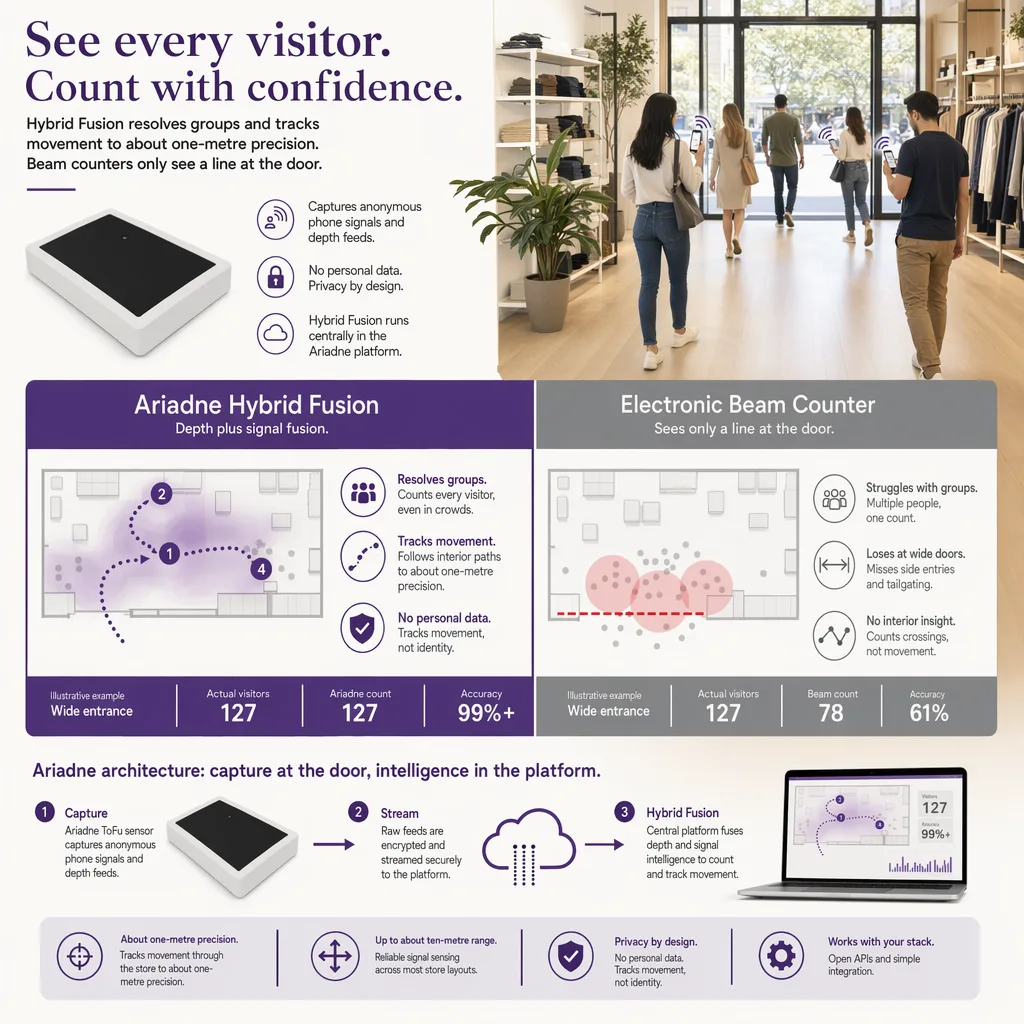
On privacy, the honest position is that both methods keep PII out of the count. Ariadne captures no PII at the sensor, so there is nothing to anonymise, and because no biometric identification or categorisation takes place, the method sits outside the EU AI Act's Annex III biometric categories. That is a shared strength with a beam, not a stick to beat one with, and the real separation between the two is accuracy on hard cases and the interior journey.
What to verify before signing
Before committing to either system, put three things in writing.
Verify accuracy on your own site. Ask for a trial on one representative entrance, run it during a genuinely busy period, and compare the automated count against a manual ground-truth count. This is the single most useful step, because it replaces a datasheet claim with a number from your own door. Groups and wide entrances are where a beam and a depth counter most often diverge, so choose a door that actually tests that.
Verify what you get beyond the count. If you need dwell, routes, or zone-level data, confirm whether the system delivers a doorway count or an interior visit path, and check any interior-analytics claim on the vendor's own site rather than taking a summary at face value.
Verify five-year cost, not the unit price. Scope hardware, install, cabling or power, and per-door software across the period for the number of doors you actually have.
For the wider field, see the systems comparison, and for a counter compared the same way, FootfallCam compared the same way. The people counting buyer's guide is planned as a sibling post; until it ships, the systems comparison covers the field. When you brief vendors, the RFP questions to ask make answers comparable across a shortlist. For the camera-free method itself, see Ariadne's camera-free counting.
FAQ
Is Countwise a camera-based people counter?
No. Countwise uses electronic beam counting with analytics, per its public documentation, and is an active brand owned by Kepler Analytics since January 2023. A beam draws a line across the doorway and counts when it is broken, so the comparison with Ariadne is not camera versus camera-free. It is a doorway beam against depth sensing plus interior fusion.
Do I need cameras to count people?
No. Ariadne counts with Hybrid Fusion: Time-of-Flight depth sensing plus patented phone signal sensing, never cameras. Time-of-Flight captures geometry rather than images, and signal sensing captures no MAC address by default, so the measurement involves no video, no faces, and no biometric data.
How is Ariadne different from a beam counter like Countwise?
The two differ on accuracy for hard cases and on coverage. Depth sensing separates people by geometry, so it tends to hold up better than a broken-beam count on groups and wide doorways, and Ariadne's phone-signal layer adds an interior visit path rather than only a doorway count. On privacy the two are close, since neither captures PII at the sensor.
Is a beam counter accurate enough?
For a single narrow doorway with light traffic, a beam can be adequate. It is most exposed where people arrive in groups or abreast, at wide entrances, and in busy doorways, because a broken beam cannot always separate individuals. The way to know for your site is to run a trial against a manual ground-truth count during a busy period.
Does Ariadne show where visitors go inside, not just the entrance count?
Yes. Time-of-Flight depth counts at the entrances and patented phone-signal sensing follows movement through the interior, so the output is a visit path with dwell and routes, not only a doorway tally. A doorway beam counts entries but does not show the interior journey; confirm any competing interior-analytics claim on the vendor's own site.


