
A cinema knows precisely how many seats it sold. What it does not know is how the lobby behaved around each screening: when the crowd actually arrived, how long they lingered at the bar, and how many people walked in without a ticket at all. Those are the numbers that decide whether the concession queue moved or stalled, and concession is where a multiplex makes a large share of its margin. Ticket data tells you the auditorium was three-quarters full. It does not tell you the bar was three deep at 19:40 and empty by 19:55, which is the information you would actually staff to.
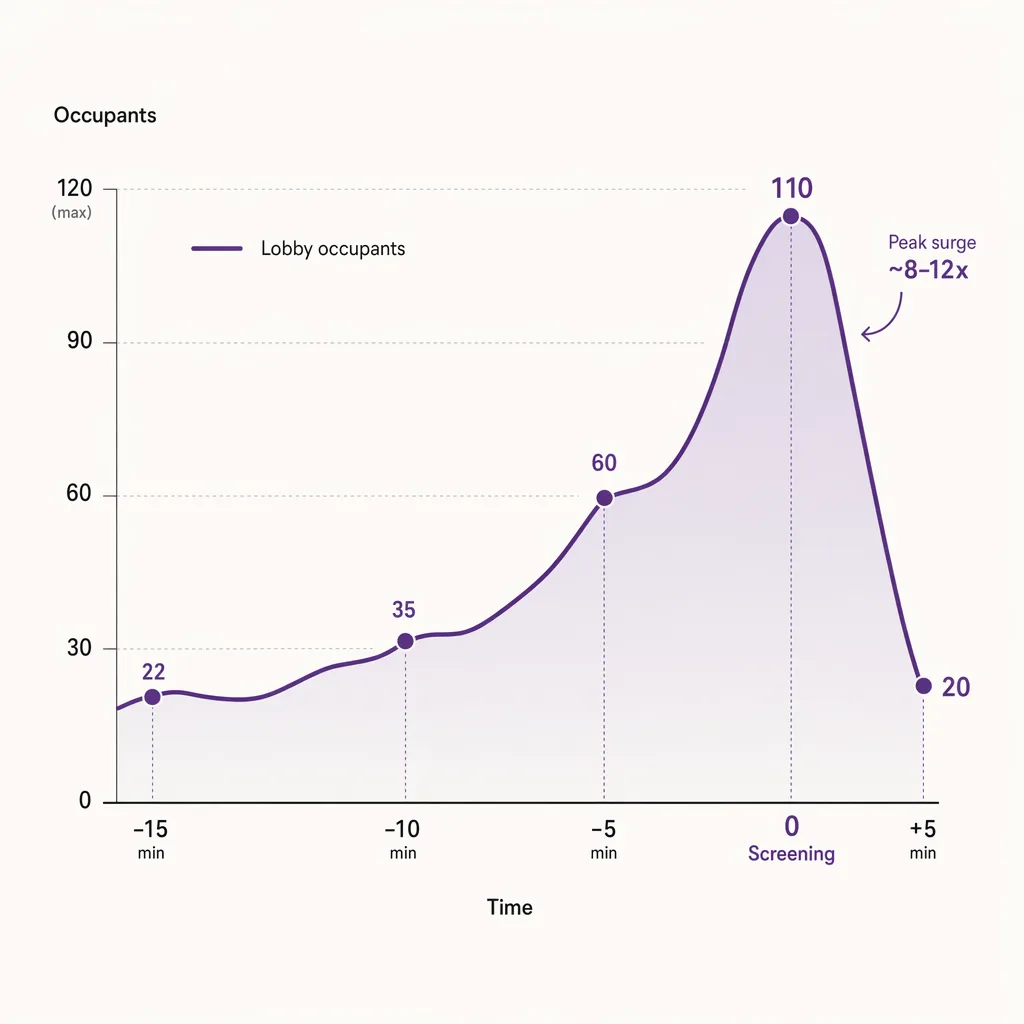
This is a guide to foot-traffic counting in a cinema lobby and concourse. It covers the arrival surge before a screening, concession conversion at the bar and snack counter, how to count a busy public lobby without putting cameras on guests, and how a duty manager turns the live and historical numbers into the staffing and timing calls that protect concession margin.
Why count foot traffic in a cinema?
Ticket sales tell a cinema how many seats sold, not how the lobby and concession behaved around each showing. Foot-traffic counting captures the arrival surge before a screening, the dwell at the bar and snack counter, and the walk-ins who came without a ticket. That sets concession staffing to the real surge rather than the screening times, and shows whether a quiet bar is low traffic or a slow queue. The data covers the public lobby and concourse, camera-free, with no record of any guest.
The gap that matters is between the showtime on the schedule and the behaviour in the lobby. They are related but they are not the same, and only one of them is measured by the box office.
The cinema pain point: the whole audience arrives in one fifteen-minute window, and ticket data cannot staff the bar for it
Cinema demand is spiky in a way few retail formats are. A multiplex can sell tickets across the afternoon and evening, but the people for the 19:30 blockbuster mostly arrive between 19:05 and 19:25, hit the bar and the snack counter in the same few minutes, and then disappear into the screens. The lobby goes from quiet to chaos to quiet again on a fifteen-minute cycle tied to the screening grid, and several screenings can stack so their arrival windows overlap into one larger surge.
Ticket data is blind to this. It tells you the 19:30 sold well, but the box-office timestamp is when the seat was bought, often days earlier online, not when the person walked through the door. So the manager staffing the concession is working from the screening grid and instinct, and the result is the familiar failure: a queue that snakes back through the lobby right before a big screening, people giving up on a drink because they will miss the trailers, and margin walking unsold into the dark. After the rush, the same staff stand idle. Staffing to the screening clock is not the same as staffing to the arrival curve, and the gap between them is lost concession revenue.
The economics make this worse than it first looks. Concession carries a far higher margin than the ticket, so a drink or a tub of popcorn lost to a slow queue is worth more to the bottom line than the seat itself. A multiplex can sell out a screening and still leave a meaningful share of its profit on the table because a third of the audience hit a stalled bar, gave up, and went straight to their seat. The lost sale is invisible in every report the cinema runs, because nothing records the person who decided the queue was not worth missing the trailers for. The only way that loss becomes visible is to count the lobby and compare the surge to what the concession actually rang up.
Arrival surge and lobby dwell around showtimes
Counting the lobby turns the arrival pattern into something you can see and plan against. Instead of "the 19:30 is busy," you get the actual shape: people start arriving here, the surge peaks at this minute, dwell at the bar runs this long, the lobby clears by here. Across a week that pattern is stable enough to staff to. The Friday evening stack of screenings produces a different curve from a quiet Tuesday matinee, and the schedule that the concession follows should match the curve, not the average.
Dwell is the second half of it. A crowd that arrives early and lingers is a concession opportunity; a crowd that arrives late and rushes the doors is a queue you will lose sales to. Live lobby counts let a duty manager see the surge building and move a second person onto the bar before the queue forms, rather than reacting once it has already cost a round of sales.
The shape of the curve also differs in ways the schedule cannot tell you. A family matinee fills the lobby slowly and lingers, because parents are buying snacks and managing children, so the concession opportunity is long and the queue rarely spikes. A Friday-night blockbuster with several screenings stacked together produces a short, violent surge where the bar is the bottleneck for fifteen minutes and dead before and after. The same staffing plan cannot serve both, and the screening grid does not distinguish them, because both are simply "a busy evening" on paper. The arrival curve does, and it is stable enough week to week that a manager can build a different concession plan for the matinee shape and the blockbuster shape rather than running one rota against both.
Concession conversion: footfall to the bar and snack counter
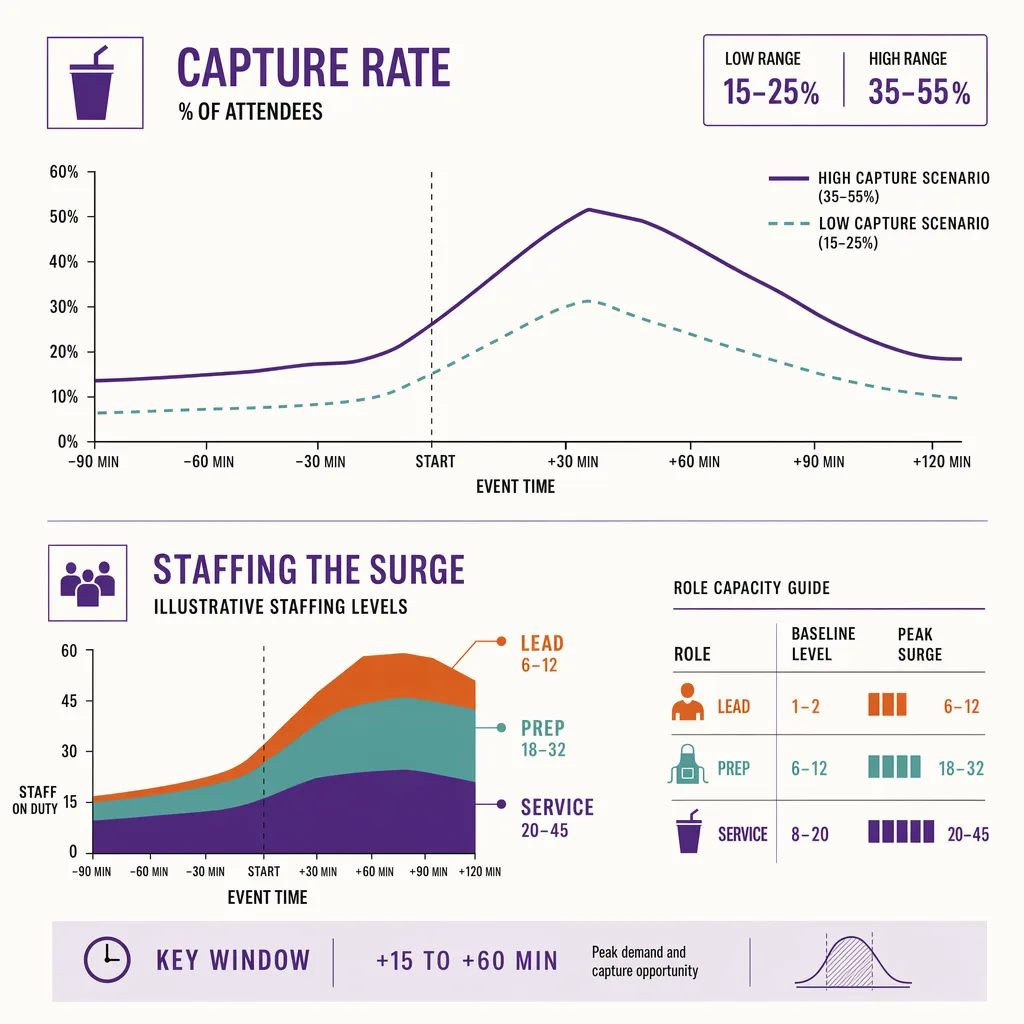
Concession is where the counting pays for itself, because it lets you measure the bar the way a retailer measures a shop. How many people came through the lobby, and how many of them bought something at the counter? That ratio is a concession capture rate, and it answers the question takings alone cannot: when the bar is quiet, is it because few people came in, or because the queue was slow enough that people gave up?
Those two causes need opposite responses. Low traffic is a programming or marketing question. Low capture on good traffic is an operations question: more staff at the surge, a faster till layout, a pre-order option, clearer pricing that speeds the decision. Without the footfall denominator you cannot tell which one you are looking at, so you cannot fix the right thing.
Capture rate measured against the surge, rather than against the whole evening, is the version that actually drives a decision. Averaged across a quiet Tuesday and a packed Friday, the number tells you little. Read at the peak fifteen minutes before a big screening, it tells you exactly where the bottleneck bites: if capture collapses precisely when the lobby is fullest, the queue is throwing away the most valuable sales of the week, and an extra person on the bar for that window is the obvious move. The same logic extends to comparing service points. If the snack counter holds its capture through a surge while the bar's collapses, the bar is the constraint, and that points at till layout or a self-service option rather than simply more bodies.
Counting the public lobby without cameras on guests
A cinema lobby is a relaxed, social space, and guests do not expect to be filmed buying popcorn. Cameras over a concession counter, even purely for counting, are the wrong tool in a leisure environment, and they bring the compliance weight of recording identifiable people for no reason the count requires.
Ariadne measures this with Hybrid Fusion, its patented camera-free method. Time-of-Flight depth sensing counts every visitor at the entrances, capturing geometry rather than images, while patented phone signal sensing follows movement through the interior, detecting the signals a phone emits even in airplane mode, and tracks that movement to about one-metre precision. The sensor streams both feeds to Ariadne, where Hybrid Fusion combines them into one trajectory per visit and computes counts, dwell, and paths. The streams carry no identifier: no MAC address, no device ID, no biometric data, and no camera is involved. Identifiers are stored only when a visitor explicitly opts in, which keeps the method GDPR-friendly and outside biometric territory.
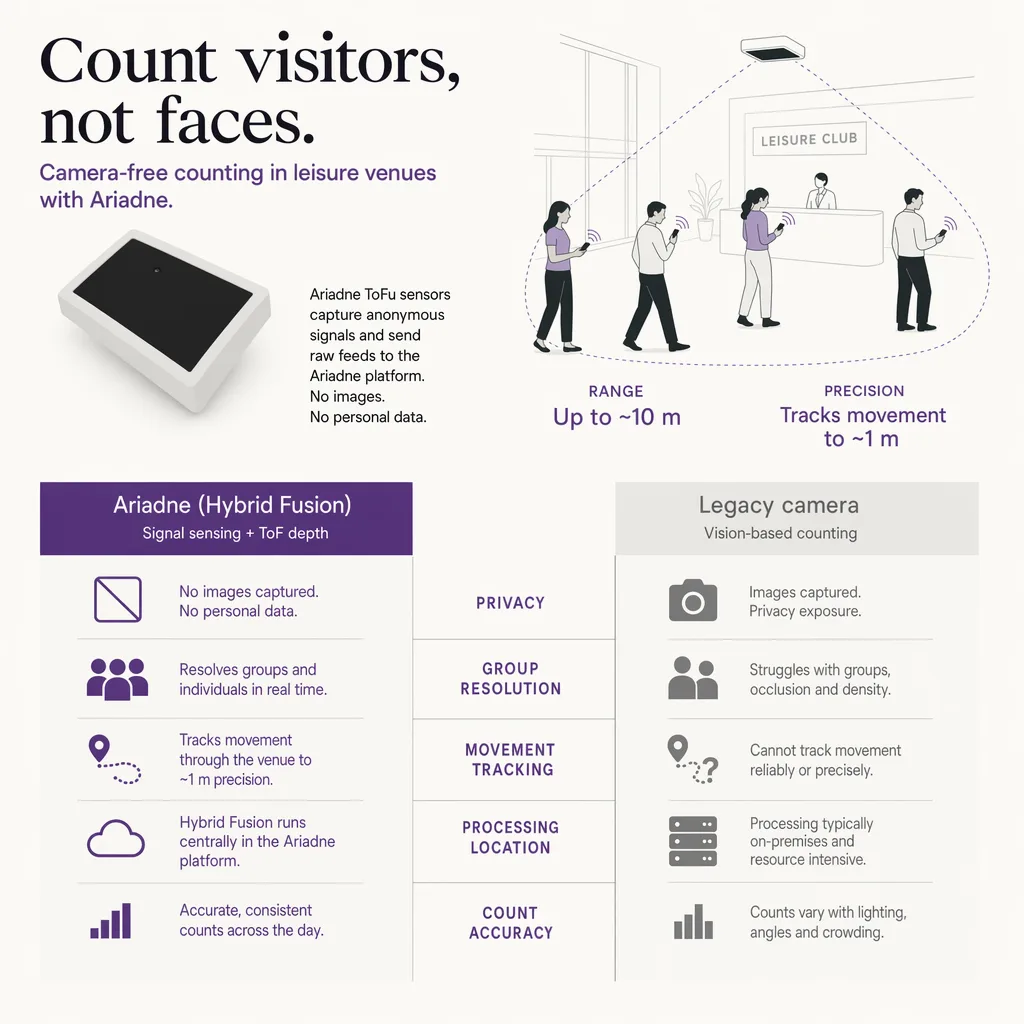
In a cinema that means the lobby and concourse are measured for arrival surges and concession dwell with no footage of any guest and nothing personal stored. If the alternative on the table is a camera over the bar, camera-free counting gets you the operational numbers without the surveillance feel or the data-protection paperwork that comes with filming customers.
From counts to action: concession staffing, signage timing, off-peak offers
The lobby data drives three practical moves.
Concession staffing is the headline. Once you can see the arrival curve for each part of the week, you put bar and counter staff on for the surge and pull them when the lobby empties, instead of running a flat shift that is both understaffed at the rush and overstaffed in the lull. Staffing to the surge rather than the clock is the single biggest lever the data gives you.
Signage and promotion timing is the second. If you know the lobby fills fifteen minutes before the big screenings, that is when a combo offer or a new-release trailer on the lobby screens reaches the most people. Timing the message to the surge rather than running it flat all day makes the same screen work harder.
Off-peak offers are the third. The data shows the dead windows as clearly as the peaks: the quiet weekday afternoons, the gaps between screening stacks. Those are the slots a discounted matinee or a loyalty offer should target, because filling a genuinely empty window adds margin rather than discounting a queue that would have bought anyway. Acting on the data is the difference between a lobby you react to and one you run on a plan.
How a duty manager actually uses the numbers
For the person running the floor on a Friday night, the data works on two clocks. The live count is the one they watch during the shift: a screen at the duty desk showing the lobby filling lets them call a second person onto the bar at the moment the surge starts to build, before the queue forms rather than after a manager notices it from across the lobby. That single early call is the difference between a queue that moves and one that costs a round of sales. The historical curve is the one they use the week before, when building the rota: the matinee shape and the blockbuster shape each get the cover their own arrival pattern needs, instead of a flat evening shift that is wrong at both ends. Over a season, the capture-rate read closes the loop, showing whether the staffing changes actually lifted the share of the surge that bought, or whether the bottleneck moved to the till layout and needs a different fix. The manager is not running a model; they are answering three questions a week, is the bar staffed for tonight's shape, did last week's changes hold, and where is the queue still costing us sales.
FAQ
How is cinema foot traffic different from ticket sales?
Ticket sales count seats sold, and the timestamp is usually when the booking was made, often days earlier online. Foot traffic counts when people actually arrive in the lobby and how they move around the bar and concession. The two answer different questions: tickets tell you the auditorium was full, footfall tells you the lobby was chaos at 19:40, which is what you staff the bar to.
Can foot-traffic counting tell me if my concession is understaffed?
Yes, indirectly and usefully. By comparing lobby footfall to concession transactions you get a capture rate. If a lot of people come through but few buy during a surge, the likely cause is a slow queue, which points to understaffing at the peak rather than weak demand. A quiet bar with low footfall is a different problem.
Does counting the cinema lobby mean putting cameras on guests?
No. Ariadne counts camera-free, using Time-of-Flight depth sensing and phone-signal sensing, so the lobby and concourse are measured with no video of guests and no biometric data. That suits a leisure space where people do not expect to be filmed buying snacks.
Can I see the arrival surge live during the evening?
Yes. Real-time counts let a duty manager watch the surge build before a big screening and move a second person onto the bar before the queue forms, rather than reacting after it has already cost sales.
Why does concession matter more than ticket revenue for staffing?
Concession carries a much higher margin than the ticket, so a drink or snack lost to a slow queue costs the bottom line more than the seat. A sold-out screening can still leave significant profit on the table if a share of the audience hit a stalled bar and gave up. Staffing the bar to the arrival surge protects the high-margin revenue that ticket sales alone never reveal.
Does the arrival curve change with the type of screening?
Yes, and that is the point of measuring it. A family matinee fills slowly and lingers, giving a long, gentle concession window. A blockbuster with stacked screenings produces a short, sharp surge where the bar is the bottleneck for a few minutes. The screening grid treats both as a busy evening; the arrival curve tells them apart so each gets the right staffing plan.
---


