
If you are searching for a Brickstream alternative, the first job is a factual one: confirm what Brickstream is today. The brand has changed hands over the years, moving from FLIR to Teledyne, and it is currently sold and supported as Teledyne Brickstream 3D Gen2, a 3D stereo-vision counter (see Teledyne's own product page). So this is not a comparison against a dead product. It is a comparison between an active 3D camera-based counter and a camera-free method, which is where Ariadne fits.
Comparisons cite public documentation; no client relationship or disparagement intended.
This post compares the two the way a buyer should compare any counter: on accuracy verified at your own doors, on what the sensor records about each visitor, on the install and support model, and on five-year cost. Ariadne is a camera-free option, so the sharpest difference is in what gets captured at the door. The rest of the comparison is the same discipline you would apply to any shortlist.
What is a Brickstream alternative?
A Brickstream alternative is worth comparing on four things: accuracy verified at your own doors, what the sensor records about each visitor, the install model, and five-year cost. Ariadne counts camera-free with Hybrid Fusion, Time-of-Flight depth at entries plus patented phone-signal sensing inside, fused in the platform, recording no MAC address by default and no biometric data. Teledyne Brickstream 3D Gen2 is an active, currently sold 3D stereo-vision product, per Teledyne's public documentation, so the honest contrast is not "is it discontinued" but "camera-based 3D vision versus a camera-free method." Compare any shortlist on a like-for-like trial rather than on a datasheet number.
Because the "is Brickstream still around" question is what sends many buyers looking for an alternative in the first place, it is worth settling plainly. Teledyne markets Brickstream 3D Gen2 as a current product with a stated lead time, so a comparison against it is a comparison against something you can still buy. What you are really weighing is not availability but method: a stereo-vision camera at the ceiling versus a camera-free sensor at the door.
The four axes that decide a counting purchase
Most counting decisions come down to the same four questions, and the order matters.
The first is accuracy on your own site. A datasheet figure is measured in the vendor's conditions, not yours. Wide entrances, groups arriving together, glass frontage, and low light all move real-world accuracy, and the only number worth acting on is the one you measure at your own doors against a manual ground-truth count. You can verify an accuracy claim on your own site with a short observed count during a busy period.
The second is what the sensor records about each visitor. A stereo-vision counter processes an image of the scene to detect and track people; a camera-free counter never forms an image at all. That difference decides how much privacy documentation you carry, which works-council conversations you need, and how the deployment reads to a data protection officer.
The third is the install model: where the sensor mounts, whether it needs cabling or power over Ethernet, ceiling-height requirements, and how a multi-site rollout is coordinated.
The fourth is five-year cost, not the sticker price. Cabling, mounting, recalibration, and per-door software all sit inside the real figure, which is why the honest comparison is total cost of ownership over the period, not the price of one unit.
Brickstream vs Ariadne, at a glance
The table below compares the methods. The Teledyne Brickstream column reflects its public product documentation as a 3D stereo-vision counter; where a figure depends on your own configuration or is not published, verify it on the vendor's own site. The Ariadne column is the canonical camera-free posture. Neither accuracy cell states a percentage as fact, because the only accuracy worth trusting is the one measured at your doors.
| Comparison point | Teledyne Brickstream 3D Gen2 | Ariadne |
|---|---|---|
| Sensing method | 3D stereo-vision (per Teledyne product documentation) | Camera-free Hybrid Fusion: Time-of-Flight depth at entries plus patented phone-signal sensing inside |
| What it records about visitors | Processes scene imagery to detect and track people; confirm capture and retention on the vendor's own site | No MAC address by default, no device ID, no biometric data, no camera |
| Camera involved | Yes (3D stereo-vision) | No |
| Interior journeys or entrance line only | Confirm on the vendor's own site | Full interior path via phone-signal sensing, not only a doorway line |
| Verified-on-site accuracy | Verify on your own site against a manual count | Verify on your own site against a manual count |
| Currently sold and supported | Yes, as Teledyne Brickstream 3D Gen2 | Yes |
| Five-year cost basis | Hardware, mounting, cabling, software; scope on your own site | Hardware, install, subscription; scope on your own site |
Where Ariadne differs on its own terms
The clearest difference is what happens at the door. A stereo-vision counter needs an image of the scene to work. Ariadne never forms one.
Ariadne measures this with Hybrid Fusion, its patented camera-free method. Time-of-Flight depth sensing counts every visitor at the entrances, capturing geometry rather than images, while patented phone signal sensing follows movement through the interior, detecting the signals a phone emits even in airplane mode, and tracks that movement to about one-metre precision. The sensor streams both feeds to Ariadne, where Hybrid Fusion combines them into one trajectory per visit and computes counts, dwell, and paths. The streams carry no identifier: no MAC address, no device ID, no biometric data, and no camera is involved. Identifiers are stored only when a visitor explicitly opts in, which keeps the method GDPR-friendly and outside biometric territory.
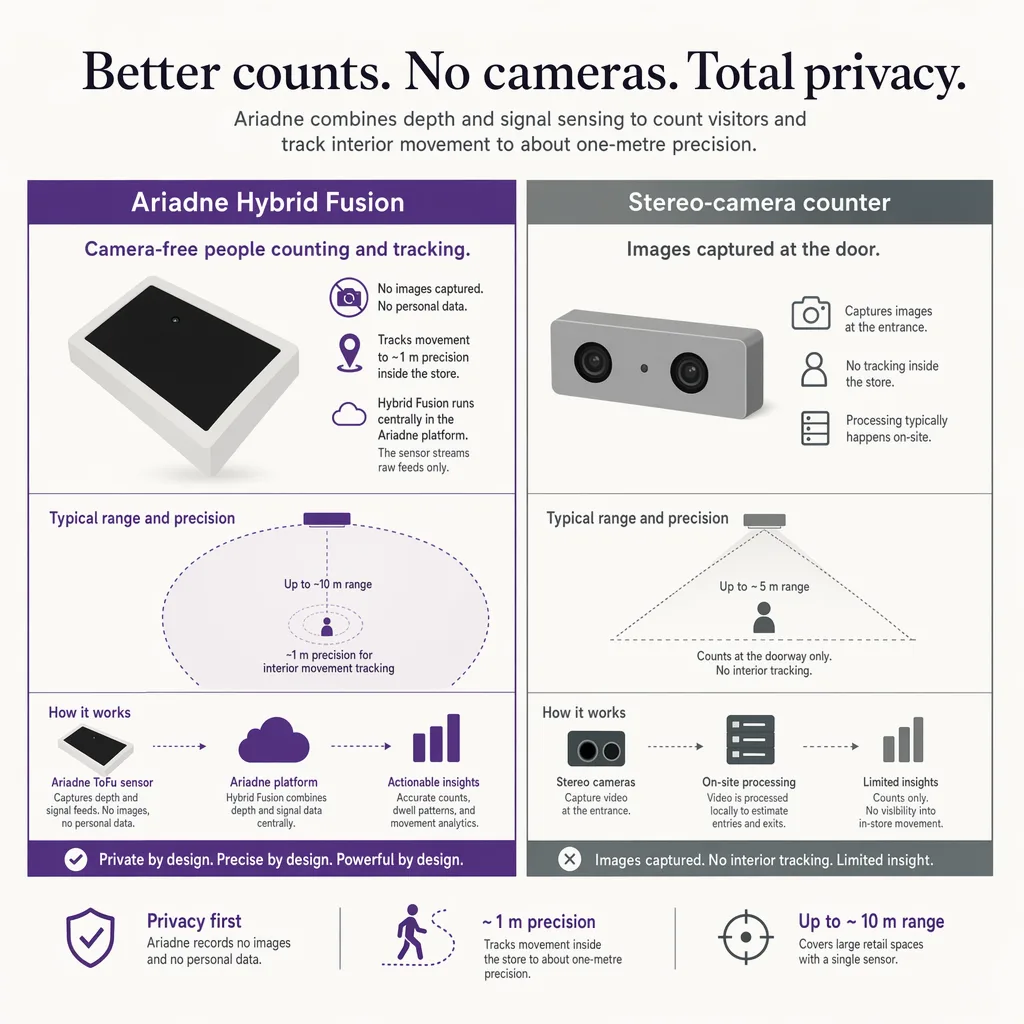
Two consequences follow that matter to a buyer. First, there is no PII captured at the sensor, so there is nothing to anonymise later, because there is nothing personal in the stream to begin with. Second, because no biometric identification or categorisation takes place, the method sits outside the EU AI Act's Annex III biometric categories. That does not eliminate your compliance work, but it changes its shape: a camera-free deployment is a different documentation exercise from installing image sensors over an entrance.
There is also a coverage difference the door-count table does not fully capture. A stereo-vision counter at the entrance measures the line people cross. Ariadne's phone-signal sensing follows movement through the interior, so the output is a visit path, not just an in-and-out tally. For a mall, an airport, or a large store, that interior view is often the reason the count is worth having.
Migrating off a legacy counter
Buyers replacing an older counter usually worry about three things: support continuity, data continuity, and the risk of a bad swap.
Support continuity is the reason many Brickstream searches start, so confirm it directly with Teledyne rather than assuming. If the product is supported and fits, staying may be the right call; the point of an alternative is a genuine choice, not a forced move.
Data continuity matters when you have historical counts you rely on for year-on-year reporting. Any change of method introduces a step in the series, and the honest way to handle it is a period of parallel running, where the old and new counters run side by side so you can quantify the offset rather than pretend there is none.
The safe way to de-risk the swap is a pilot. Put the new counter on one representative entrance, run it against a manual ground-truth count during a busy period, and only then decide on a full rollout. You can run a migration pilot on a single door before committing the estate. For the wider field of options, see the current systems comparison and, on sensor types specifically, stereo vs ToF vs thermal sensors. A side-by-side system comparison is planned as a sibling post; until it ships, the systems comparison above covers the field. For the camera-free method itself, see Ariadne's camera-free counting.
FAQ
Is Brickstream still sold?
Yes. The brand is currently sold and supported as Teledyne Brickstream 3D Gen2, a 3D stereo-vision counter, per Teledyne's public product documentation. The brand moved from FLIR to Teledyne over the years, which is the ownership history behind the "is it still around" question, but the product itself is active. A comparison against it is a comparison against something you can still buy.
Do I need cameras to count people?
No. Ariadne counts with Hybrid Fusion: Time-of-Flight depth sensing plus patented phone signal sensing, never cameras. Time-of-Flight captures geometry rather than images, and signal sensing captures no MAC address by default, so the measurement involves no video, no faces, and no biometric data.
How is Ariadne different from a 3D stereo-vision counter like Brickstream?
A stereo-vision counter forms an image of the scene to detect and track people. Ariadne never forms an image: Time-of-Flight depth captures geometry at the door and phone-signal sensing follows movement inside. That means no biometric data and no camera, and it adds an interior visit path rather than only an entrance line.
How do I compare Brickstream and Ariadne fairly?
Trial both on the same representative entrance during a busy period and compare each against a manual ground-truth count. Datasheet accuracy rarely survives a real door, so the number that should decide the purchase is the one you measure on your own site, alongside what each system records and its five-year cost.
Which is better for measuring the whole visit, not just the entrance?
A camera-free method with interior sensing follows the visit path through the building, not only the line at the door. If you need dwell and route data across a mall, airport, or large store, that interior view is the deciding factor. Confirm any competing product's interior coverage on the vendor's own site.
---


